 By HUBERT VAZ
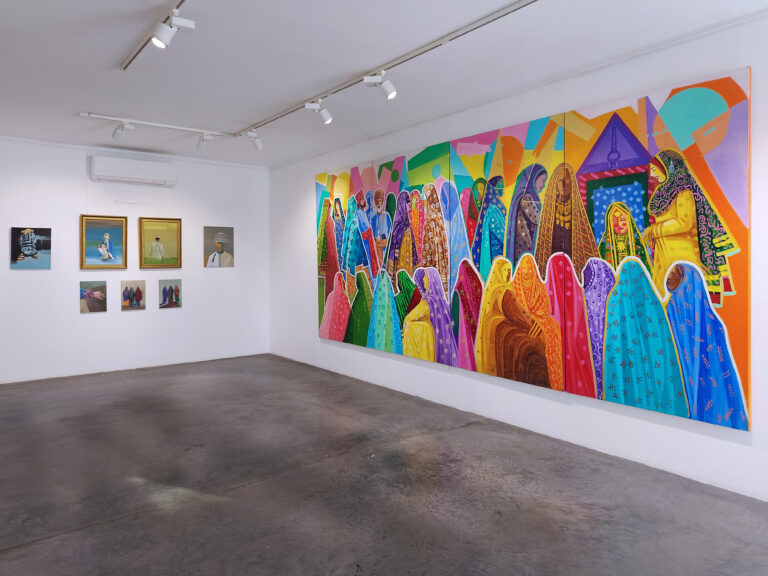
Stal Gallery’s annual Summer Exhibition under the theme ‘Natural landscapes and cultural traditions of Oman’ brings together 12 artists whose works explore landscapes, memory, heritage and identity, offering visitors a richer portrait of Oman than any travel itinerary could
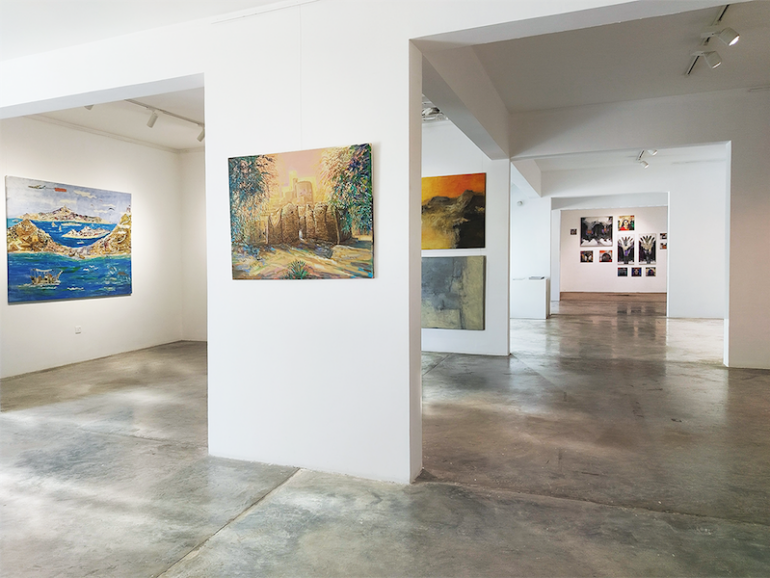
A walk through Stal Gallery’s Summer Exhibition is like travelling across Oman without leaving Muscat… Despite the limited space at one’s disposal here, for a joint exhibition featuring 12 artists, the visitor gets instantly transported into a realm that seamlessly cascades Oman’s past and present via brushstrokes that create a timeless phenomenon.
One moment, you’re standing beneath the weathered walls of Old Muttrah where Arabic calligraphy appears to seep from stone. The next, you’re crossing sunlit dunes inscribed with flowing script, before arriving at the cool blues of an imagined ocean or a collage pieced together from recycled fragments of memory.
Rather than presenting a single vision of Oman, this year’s exhibition invites visitors to see the country through 12 distinct artistic voices. Landscapes, architecture, traditional crafts and centuries-old symbols become starting points for conversations about identity, sustainability, history and belonging.
Now a fixture of Muscat’s cultural calendar since its launch in 2015, Stal Gallery’s Summer Exhibition has become an annual meeting point for established Omani artists and carefully selected international guests. This year’s edition features works by esteemed artists like H H Sayyidah Afra Al Said, Adnan Al Raisi, Juma Al Harthi, Anwar Sonya, Hassan Al Meer, Mohamed Mehdi Jawad Al Lawati, the late Moosa Omar, Idris Al Hooti, and Hussain Obaid, alongside guest artists Afsaneh Moslehi, Tarini Agarwal and Janin Walter.
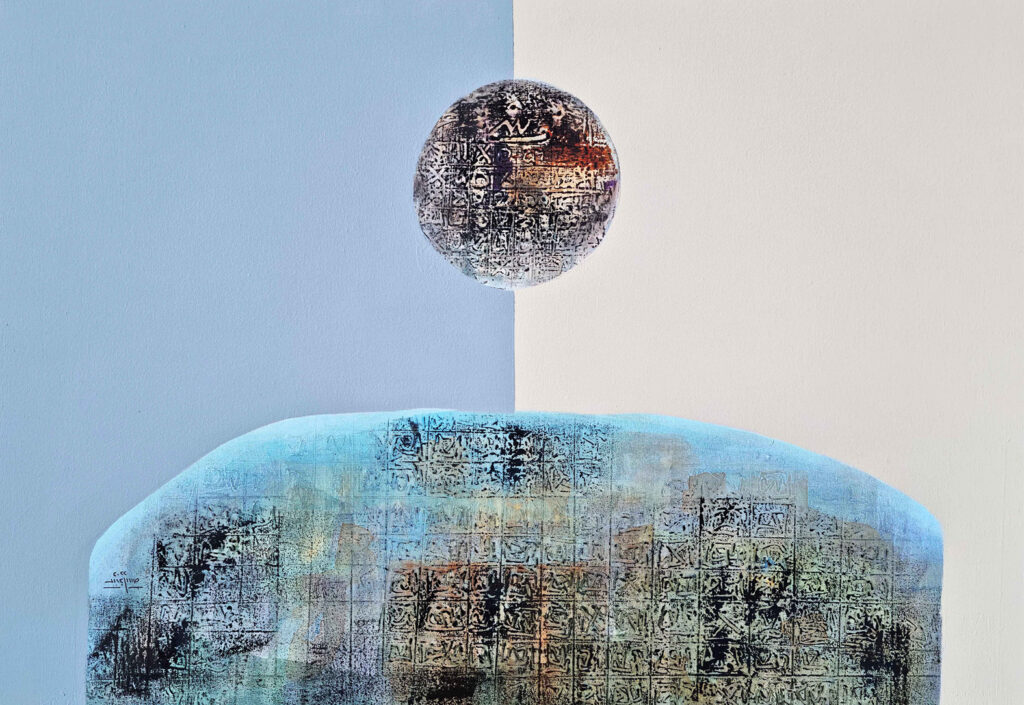
For gallerist Volodymyra Sobolevska, the exhibition has grown into something more enduring than an annual showcase. With her penchant for always striding aside the beaten track, Sobolevska sees this exhibition, not just as a two-dimensional offering, rather as an opportunity for collaboration and communication among artistic voices.
“Stal Gallery provides a platform for Omani and invited international artists, encouraging international dialogue and serving as a platform for cultural exchange,” she says. “Each edition of the Summer Exhibition forms a living archive of artists, concepts and artworks, reflecting new contemporary art perspectives on Oman.”
That dialogue is immediately evident in the exhibition itself. Although every artist responds to the theme of Oman’s natural and cultural landscapes, no two approaches are alike. Painter Anwar Sonya turns his attention to Nakhal, Manah and Sur – places he visited during live painting sessions earlier this year. Working from direct observation rather than photographs, he captures changing light, atmosphere and texture with loose impressionistic brushwork. His experience of witnessing traditional outdoor dances during his travels also finds its way into the paintings, adding a human rhythm to the landscapes.
Idris Al Hooti transforms Old Mutrah into a poetic visual narrative. Arabic calligraphy flows across the facades of historic houses, suggesting that buildings themselves can preserve stories. Rich reds echo the intensity of the Omani sun, while subdued greys hint at memory, age and the passing of generations.
Language appears throughout the exhibition in unexpected forms. Mohamed Mehdi Jawad Al Lawati’s ‘Peace 2’ strips calligraphy back to its expressive essence, allowing letterforms to communicate harmony beyond words. Iranian artist Afsaneh Moslehi also uses Arabic script, but places it within sweeping desert landscapes where the written word becomes part of the terrain itself, carrying stories across shifting sands.
Some artists revisit Oman’s architectural and craft traditions through a contemporary lens. Like Juma Al Harthi, who draws inspiration from ancient inscriptions carved into the ceilings of Jabreen Castle and the historic doors of Nizwa, reinterpreting their geometric language through painting and sculpture. And Adnan Al Raisi who references khos, the traditional craft of weaving palm fronds, incorporating its circular forms and textures into works that speak quietly of cultural identity and continuity.
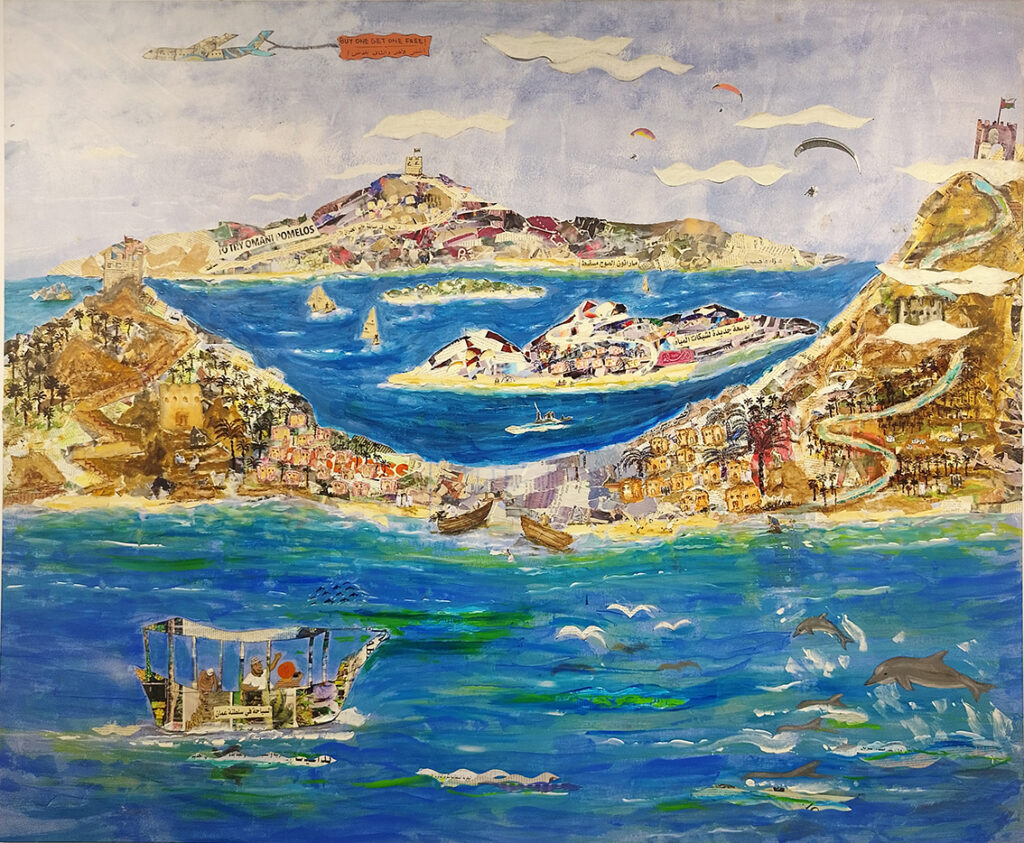
The exhibition also reflects a growing interest in sustainable practice. Sayyidah Afra presents three collages created from recycled materials which explore the relationship between land and sea, celebrate the nation’s evolving identity in ‘Our Country’ and revisit personal reflections in ‘Recycled Memories’. Late Moosa Omar’s works also embrace natural materials, using jute to reinterpret traditional Omani symbols in a contemporary context, demonstrating how sustainability and heritage can coexist.
As for Hassan Meer’s figurative painting from 2003 (shown publicly at Stal Gallery for the first time), it draws upon memory and Omani folklore, while Hussain Obaid’s compositions revisit ancient signs and inscriptions charged with emotional and historical significance.
The international guest artists at this show expand the exhibition’s geographical reach without losing sight of its central themes. German artist Janin Walter’s ‘Color Codes of the Ocean’ explores the shifting palette of marine environments, taking inspiration from ocean depth zones, fish and underwater ecosystems. And Tarini Agarwal responds to quieter landscapes, transforming everyday scenery into contemplative compositions that blur the boundaries between observation and meditation.
Sobolevska, who believes that every visitor experiences the exhibition differently, asserts, “Tourists discover landscapes, traditions and everyday life that aren’t found in travel guides. For local visitors, it’s an opportunity to reflect on Oman’s history and transformation through the eyes of artists. And for the participating artists themselves, it’s a place to exchange ideas, develop new concepts and begin planning future collaborations.”
During the summer, those conversations continue beyond the gallery walls through guided educational tours that introduce visitors to artistic techniques, historical references and the stories behind individual works. Students, educators and families are encouraged to engage with the exhibition not simply as spectators, but as participants in an ongoing dialogue about art and culture.
In an age when destinations are often reduced to snapshots and social media highlights, Stal Gallery’s Summer Exhibition offers something slower and more rewarding. It reminds visitors that landscapes are shaped not only by geography, but also by memory; that architecture preserves stories as much as stone; and that contemporary art remains one of the most compelling ways to understand a place and the people who call it home.
Don’t miss…
Anwar Sonya – Impressionist landscapes inspired by painting expeditions to Nakhal, Manah and Sur.
HH Sayyidah Afra Al Said – Three mixed-media collages made from recycled materials that explore identity, memory and place.
Idris Al Hooti – Atmospheric paintings of Old Mutrah where Arabic calligraphy becomes part of the architecture.
Juma Al Harthi – Contemporary interpretations of inscriptions and decorative motifs from Jabreen Castle and historic Nizwa.
Janin Walter – Color Codes of the Ocean, an exploration of the sea’s ever-changing palette inspired by marine life and ocean depths.
© 2021 Apex Press and Publishing. All Rights Reserved. Powered by Mesdac