 By HUBERT VAZ
At Stal Gallery, seven artists turn the Omani home into a repository of memory, identity and tradition, using paintings, textiles, patterns, and architecture
There is something immediately striking about the way What the House Knows unfolds at Stal Gallery…
When you enter this gallery, at first glance, you encounter an exhibition of paintings, textiles, portraits and architectural references. But if you look intently, you soon discover that a different kind of exhibition begins to emerge. The objects and images on display transform into living tales of clothes, celebrations, family relationships, and traditions quietly carried forward.
Opening at Stal Gallery today (September 20) at 7pm, the group exhibition brings together Saleem Sakhi, Sarah Al Aulaqi, Hassan Meer, Anwar Sonya, Mohammed Al Zadjali, Wael Hamdan and Hafsa Al Tamimi. It remains on view until October 5.
The starting point of this joint exhibition is deceptively simple – what does a house remember? For the seven artists, the answer is found not in bricks and walls alone, but in the people who inhabit them, and the rituals of everyday life.
The exhibition does not attempt to reconstruct an Omani house literally. Instead, it reconstructs the emotional world that grows around one. Clothing, patterns, architecture, childhood, motherhood and celebration become the vocabulary.
“What does a house remember? It holds traces of those who have lived within it – patterns and objects, memories, stories, celebrations and traditions,” says gallerist Volodymyra Sobolevska of Stal Gallery.
The idea becomes particularly apparent when moving between the very different works. One moment the visitor is looking at a portrait, the next, at a densely patterned garment or an architectural form. But together, they suggest that cultural memory is often embedded in things people encounter every day without necessarily stopping to examine them.
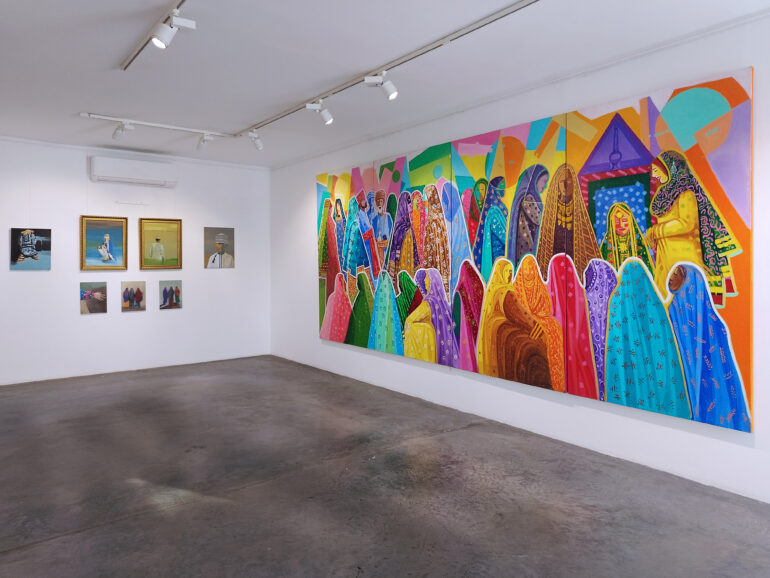
One of the exhibition’s most commanding works is Anwar Sonya’s Omani Wedding. The painting stretches across much of a gallery wall. It is populated by a crowd of figures in colourful garments, their forms compressed into a lively arrangement of geometric shapes and repeated patterns. There is movement everywhere.
The painting immediately communicates the energy of a wedding celebration, but a closer look reveals something else. The figures are not rendered in the softer Impressionist language for which Sonya is known. Their simplified, angular construction gives the work a strong Cubist influence. That makes it more than a colourful celebration and it also records a moment of experimentation in Sonya’s artistic journey.
“The movement from his established Impressionist language towards Cubism makes this work especially rare and significant within his artistic development,” Sobolevska asserts. For visitors familiar with Sonya’s earlier work, this is likely to be one of the exhibition’s most interesting discoveries.
On another wall, Saleem Sakhi turns traditional Omani dress into a portrait of identity. His works draw attention to the kumma, dishdasha and the distinctive garments worn by Omani women. The clothing is not merely what the figures happen to be wearing. It becomes part of who they are.
The exhibition makes visitors look at familiar details differently – colour, embroidery, headgear, fabric and pattern can all carry information about place, occasion, tradition and belonging.
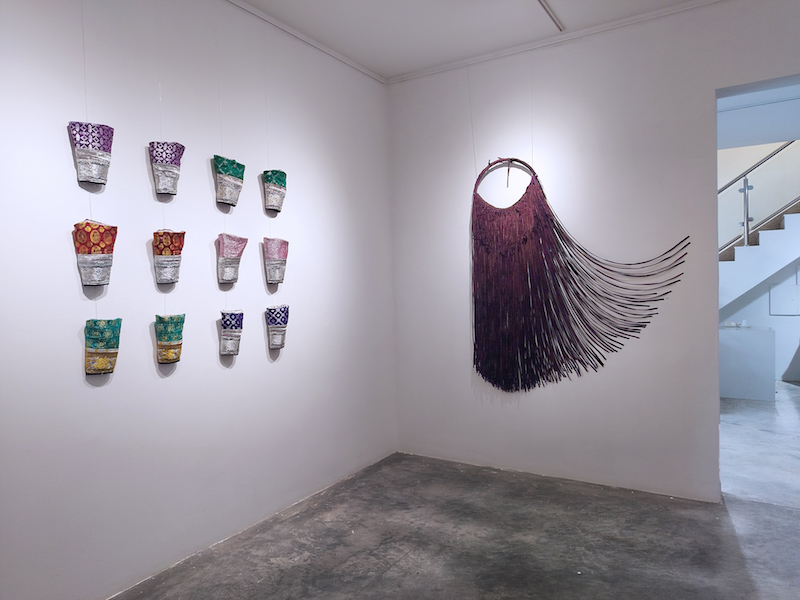
Sarah Al Aulaqi takes this relationship between textile and identity into Dhofari culture. Her works incorporate traditional cloth, head jewellery and burqa, while also reflecting the enduring practice of Omani tailoring. Seen together, the pieces make an especially tactile section of the exhibition.
Small, carefully worked textile forms are mounted across the wall, while a striking, elongated textile piece extends dramatically outward, its strands creating a sense of movement. The effect is almost sculptural.
Here, the visitor is encouraged to consider what lies behind the beauty of traditional adornment: the craftsmanship, knowledge and techniques required to produce it, and the generations through which that knowledge travels.
The emotional register changes with Hafsa Al Tamimi’s work. Her paintings turn towards motherhood and the relationship between generations. One large composition presents a mother and child surrounded by loosely defined human forms, with colour and brushwork conveying emotion more than literal detail. The faces seem to emerge and recede from the surface.
The accompanying installation is particularly striking because of its contrast between human presence and carefully presented material elements. It invites contemplation rather than demanding an immediate reading.
In the context of the exhibition, motherhood becomes another form of continuity: the transmission of values and identity from one generation to the next.
The idea of continuity becomes more intimate in Hassan Meer’s works. His Father and Son diptych brings the relationship between generations into focus, while other works move towards childhood, imagination and the legends associated with Oman’s mountains.
Meer has spoken of his childhood fascination with those stories and the influence they can have on how people understand life.
His works consequently introduce another layer to the exhibition: a home is not only where family relationships are formed, but also where stories, beliefs and imagination are first absorbed.
Across the gallery, Mohammed Al Zadjali’s works offer a very different visual experience. At first glance, the intricate compositions appear almost abstract. Look longer, however, and familiar architectural and decorative references begin to emerge.
Traditional Omani patterns become his vocabulary. One work builds an elaborate, almost tapestry-like composition from repeated motifs and geometric forms. Another presents a densely packed field of colourful architectural shapes, punctuated by domes and tiny windows.
The effect is fascinating: the viewer can move from seeing pattern as decoration to recognising it as a form of cultural memory.
Wael Hamdan approaches the theme through architecture. His Domes of the Citycollection presents an intensely populated visual world of buildings, domes, windows and geometric forms. The city becomes almost textile-like in its density, with individual structures packed together to create a larger image of place.
It provides an interesting counterpoint to the more intimate works elsewhere in the exhibition.
A building can outlast its occupants. But without people, architecture is simply structure. It becomes a home only when lives unfold within it — when people gather, celebrate, argue, grow up, leave and return. That is where the exhibition’s title begins to resonate most strongly.
What makes the exhibition engaging is that none of the seven artists attempts to provide a single definition of heritage. Instead, they approach the idea from different directions — through the human figure, family, clothing, jewellery, textiles, pattern, celebration and architecture. And the cumulative effect is to make the familiar seem worth looking at again.
And eventually the question moves beyond the gallery – What does your own house know? Which objects in it have stories attached to them? Which traditions have been repeated so often that they have become almost invisible? Which memories belong to grandparents and parents? And which of those memories will survive into the next generation?
What the House Knows does not answer these questions. Instead, it gives visitors seven different ways of thinking about them.
© 2021 Apex Press and Publishing. All Rights Reserved. Powered by Mesdac