
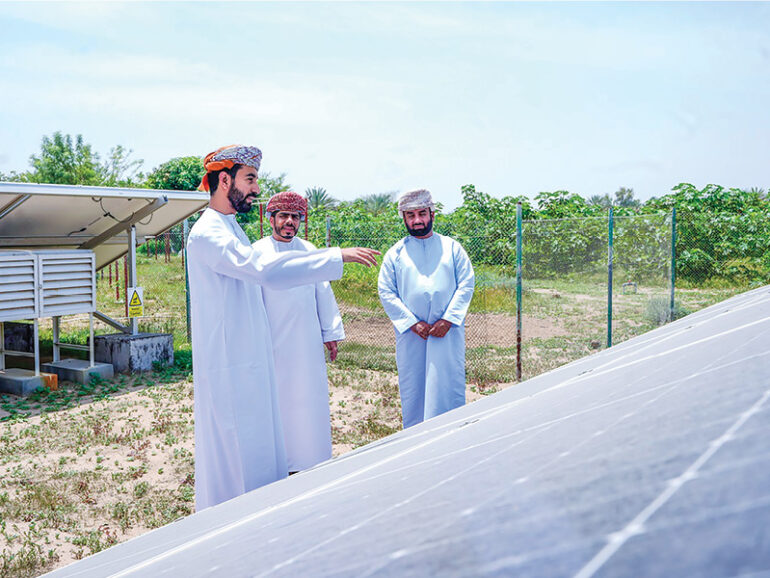
Muscat – Farmers and investors in Oman are increasingly adopting solar energy to power agricultural, livestock and fisheries projects, citing lower electricity costs, improved efficiency and long-term sustainability as key benefits.
Industry stakeholders say renewable energy has become a practical economic solution for production projects, particularly amid rising electricity tariffs and growing focus on food security and environmental sustainability. They added that Oman’s abundant sunshine throughout the year makes the sultanate ideally suited for wider use of solar power in the agriculture sector.
Eng Mohsen bin Mohammed Al Mufarji, renewable energy engineer at the Ministry of Agriculture, Fisheries and Water Resources, said the ministry is encouraging farmers, livestock breeders and investors to partially shift to solar energy as part of efforts to enhance sustainability and improve resource efficiency.
He said solar energy can support the operation of irrigation pumps, cooling systems and crop drying units, helping improve productivity and reduce operating costs. In livestock projects, solar systems are increasingly being used to operate ventilation, cooling and water pumping equipment, while in aquaculture they help power pumps and aeration systems, particularly in remote areas far from electricity grids.
“Solar energy is no longer only an environmental option, but a practical economic tool that enhances the viability of agricultural and food production projects,” Mufarji said. He added that the transition can be implemented gradually according to the needs and scale of each project.
One of the prominent national examples is the photovoltaic solar project developed by A’Saffa Foods at its farm in the wilayat of Thumrait.
Bader bin Abdullah Al Rashidi, marketing manager at A’Saffa Foods, said the project reflects the company’s commitment to sustainability and operational efficiency.
Built across a 65sqkm farm, the solar energy system covers around 91,000sqm and has a production capacity of 7MW. Rashidi said the facility uses an intelligent sun-tracking system to maximise solar capture efficiency and output.
The project includes 12,824 photovoltaic panels and 20 inverters with a capacity of 330kW each. According to Rashidi, the initiative is expected to reduce carbon dioxide emissions by approximately 6,250 tonnes annually while supporting food security goals in Oman.
Farmers have also reported major financial savings from adopting solar systems. Rashid bin Salem Al Suhaimi, owner of Bustan Al Shater farm in Suwaiq, said his farm now relies heavily on solar power after installing a 25kW system with support from the ministry.
He said solar energy now covers between 60% and 70% of the farm’s electricity needs for fish farming and agricultural operations.
“The electricity bill dropped from nearly RO350 to between RO120 and RO150 per month, which significantly improved the project’s economic feasibility,” he said.
Mansour bin Nasser Al Sunaidi, a poultry farmer from Ibra, said he installed two 30kW solar stations to power cooling systems, hatchery equipment and water pumps.
According to Sunaidi, the project reduced electricity consumption by nearly 30% annually. He added that future plans include converting the entire facility to solar energy using advanced battery storage systems capable of operating for several days without sunlight.
© 2021 Apex Press and Publishing. All Rights Reserved. Powered by Mesdac