Ever felt how calm and harmonious it is when encountering antique items or being surrounded by them? Whether it’s your father’s old radio from the 1950s or a wired telephone placed on a console, one cannot help but stare and be amazed, either by their uniqueness or by the memories flashing back instantly. A similar feeling overcame me when I first visited Birkat al Mouz in Nizwa, Oman, in 2016.
Birkat al Mouz lies about one hour and 15 minutes from Muscat, at the base of Jabal Akhdhar, 54 minutes away, and only 22 minutes from Nizwa Souq – both major tourist destinations. Though years have passed, my first impression upon arriving at the ancient settlement of Harat al Saybani remains vivid.
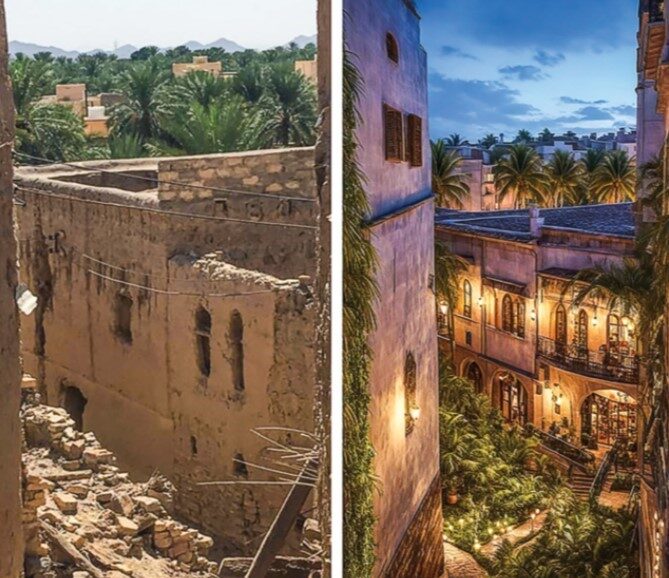
The old brick buildings embracing the palm plantations were an astonishing sight. Walking through the main entrance of these settlements towards the central stairs, which link beautifully with the main entrances of adjoining houses, I was struck by artistic curved door frames barely surviving but still adding to my unforgettable revelation of this wonderful neighbourhood. Sustainable building materials and construction techniques – from the walls and interior stairs to the roofing system – were entirely sourced locally and coordinated to ensure durability and comfort in the hot Gulf climate.
Narrow alleys within these deserted houses guided my path beside the flowing water channel, known in Oman as a falaj, which Unesco recognises for its efficiency in water distribution. Despite the deteriorated state of these houses, a strong sense of warmth and tranquillity accompanied me throughout my visit. The only thought in my mind was the close connection and sense of enclosure the occupants must have experienced in their daily lives. The shadows these buildings cast on one another created a comfortable environment to carry out outdoor duties and engage with neighbours. Imagining the stories behind these structures revealed the age of their silent existence.
Now, years later, I still appreciate the effect that struck me back then. The value of this place has been addressed by other authors and researchers, with restoration schemes discussed and initiated. Remembering my visit makes me wish I could go back in time. My thoughts run wild – what if Harat al Saybani came back to life, with people passing here and there? Its calmness would suit a wonderful bed-and-breakfast for visitors, terrace cafés overlooking the palm trees for professional meetings and family gatherings. Retail stores selling Omani halwa, frankincense or pottery would share Omani identity with tourists. A mini art centre could catalyse cultural interaction through Omani dances and displayed historical artefacts.
With all this, Harat al Saybani could relive a new era within its historical walls – creating jobs, contributing to the zero-carbon agenda, and most importantly, preserving the honour of Omani architecture for future generations.
Given the popularity of Birkat al Mouz’s old ruins and the natural attraction of historical projects, an ‘adaptive reuse’ scheme would likely succeed, offering locals and visitors a pleasant atmosphere and a place within the bigger historical narrative, while respecting restoration guidelines for such a TREASURE. If only Birkat al Mouz’s ruins could be restored carefully and with love to suit our current lifestyles, while maintaining the traditional Omani touch, those thick antique walls would have more stories to tell – and Oman would gain a heartfelt destination in Al SHUMOOKH!
[The writer, Fatma Humaid al Mahrooqi, is an Omani architect at Huckle Design. She writes to raise awareness of architecture and inspire appreciation for Oman’s built heritage. Follow her on Instagram: architecture_with_fatma]
© 2021 Apex Press and Publishing. All Rights Reserved. Powered by Mesdac