Muscat – A visitor walks through a gallery in Oman Across the Ages Museum, stopping in front of a display about Oman’s maritime history. Instead of only reading an inscribed description on a plaque, they raise their phone, and with a tap, suddenly see a 3D reconstruction of an ancient Magan-era ship appear on the screen. The vessel rotates slowly, revealing details that would otherwise remain hidden, paired with floating explanations on the side. Moments like these demonstrate how digital technology is beginning to transform the way cultural heritage is experienced.
Cultural heritage is a defining feature of the Omani tourism industry and national identity, with historic sites like forts, traditional souqs, and the ancient aflaj irrigation system, attracting visitors while also reflecting the country’s long history and cultural traditions. However, preserving these sites while continuing to promote tourism presents an ongoing challenge. As visitor numbers increase, centuries-old historical sites have to endure constant traffic, environmental exposure, and the pressure of modern tourism infrastructure. Each step taken across worn stone floors, each hand brushing against an ancient wall, may seem insignificant by itself, but over time, these small interactions accumulate, wearing away the physical traces of history.
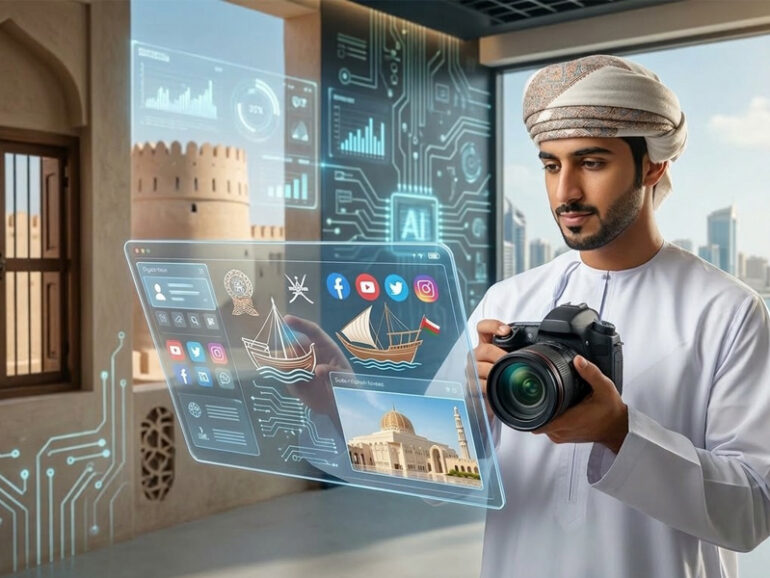
Around the world, digital technologies are used increasingly to help address this issue, with tools such as 3D scanning, virtual reality (VR), augmented reality (AR), and digital archives that allow intangible and tangible heritage sites and artifacts to be documented in high digital precision, reducing the physical wear on fragile locations while also offering new ways for visitors to explore and understand historical environments. For example, 3D scannings can create highly accurate digital models of buildings, while AR can overlay reconstructions onto real-world environments for visitors.
Digital heritage initiatives should be guided by a number of key principles, such as sustainability and long-term preservation, accessibility and inclusivity, and authentic interpretation that honours and respects cultural context and historical accuracy. While accessibility enables broader audiences to interact with cultural heritage through online platforms and virtual experiences, sustainability guarantees that digital systems will continue to be usable and maintained over time, as poorly created digital reconstructions may oversimplify, dilute, or distort historical narratives.
Ultimately, although tools such as digital archives, augmented reality, and 3D modelling can improve documentation, interpretation, and accessibility, technology is inadequate on its own. Effective governance, careful implementation, and collaboration with cultural experts are necessary to ensure that digital tools strengthen, rather than distort, the cultural narratives associated with heritage sites.
Rui Yan Lyu, Grade 8, ABA Oman International School

© 2021 Apex Press and Publishing. All Rights Reserved. Powered by Mesdac