
 By
By
Muscat – Generative AI (GenAI) is reshaping industries worldwide, with education and creative fields being prime areas of transformation.
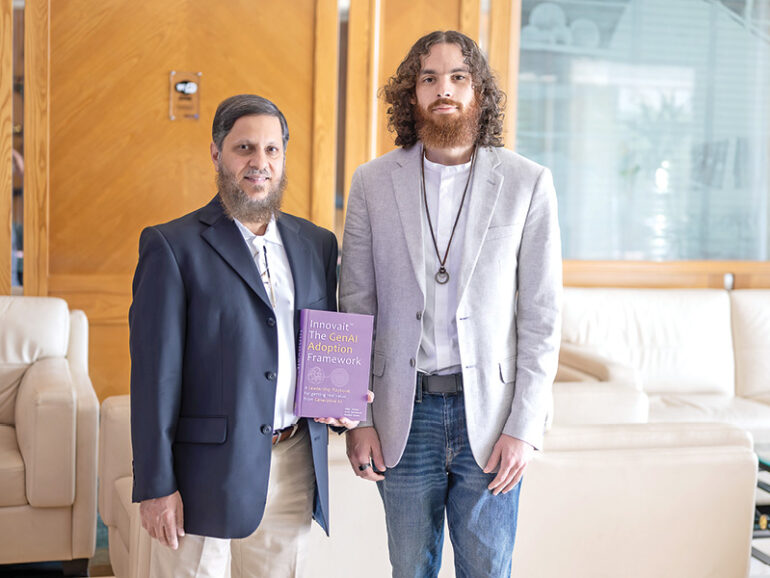
A workshop on artificial intelligence called GenAI Strategist Masterclass by experts Asim Javed and Rashid Smith was held at the Radisson Blu Hotel on Wednesday and Thursday.
Javed is the co-founder of MindPropel along with Arun Saraswat and Rashid Smith. He is also the co-author of Innovait – The Framework for GenAI Adoption: A Playbook for Getting Real Value from GenAI.
In an exclusive interview with Muscat Daily, Javed shed light on how AI technology is evolving and the ethical implications surrounding its use.
AI-driven learning revolution
Generative AI has already begun altering the traditional education landscape. However, Javed emphasises that the technology should serve as a complement to human educators rather than a replacement.
“At MindPropel, we view Generative AI as a powerful tool that enhances, rather than replaces the teacher-student relationship. AI-driven generative fill, which enables the creation of new content, can provide personalised support by tailoring educational materials to meet individual student needs. This allows for a more inclusive learning experience by breaking down language barriers and adapting content for diverse learners. Moreover, AI amplifies educational resources, accelerating feedback and creating immersive learning environments.”
Collaboration with art
In creative fields like art, film, and music, AI is often seen as a potential threat to human creativity. However, Javed has a more optimistic outlook.
“We believe AI is more of a collaborator than a competitor in creative fields,” he said. Tools such as DALL-E and FLUX have expanded the possibilities of visual art, while platforms like AIVA and Amper Music have made strides in music composition.”
Javed added that AI handles time-consuming technical tasks, freeing up artists to focus on the creative aspects that remain uniquely human. “AI can’t replicate emotional depth or lived experiences, and those remain intrinsic to the human touch in artistic expression,” he said.
Ethics and principles
While the potential of AI is promising, it raises important ethical concerns, especially around originality and authorship.
Javed said, “One of the biggest concerns we have is the blurring of lines between what is human-made and what is AI-generated. MindPropel advocates for transparency and ethical guidelines when using AI in content creation. It’s essential to disclose AI’s involvement in content creation, so audiences can make informed judgments.”
As AI tools remix existing data to create new outputs, the question of who should be credited as the author of such works becomes increasingly complex, he added. “As GenAI continues to develop, MindPropel’s focus remains on responsibly harnessing its power to shape the future.”
© 2021 Apex Press and Publishing. All Rights Reserved. Powered by Mesdac