
By Jeremy Fox
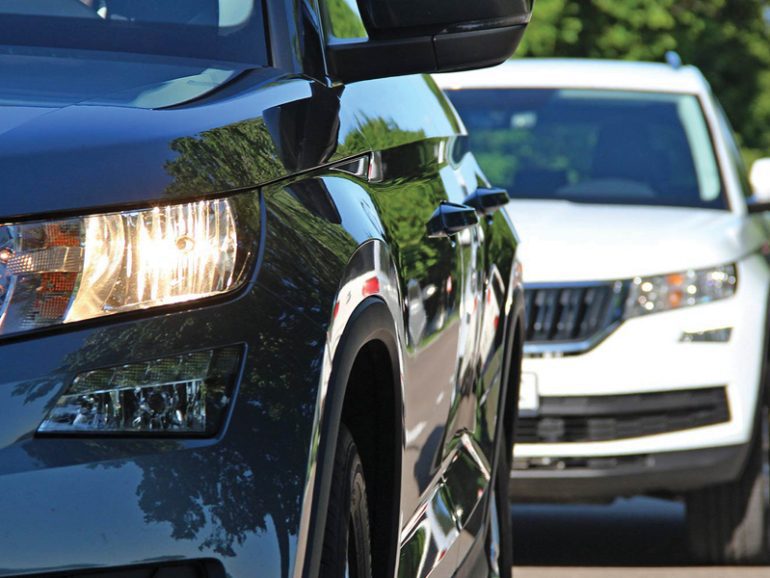
In my days as a Police Traffic Officer in the UK, I spent much of my time attending road accidents of varying severity. Without doubt, one of the most common of all the numerous scenarios I investigated was collisions caused by drivers failing to create and maintain sufficient space in front of their vehicle.
The resultant collision is often referred to as a ‘shunt’ – ie someone ahead brakes and the driver behind is so close that he is unable to stop within the space he has available, so collides with the rear of the vehicle in front.
Although the result of poor frontal spacing is sadly inevitable, it’s also easily avoidable.
Most of us who drive in Oman recognise that ‘tailgating’ – the term widely used to describe following too close – is a depressingly common sight.
So what can we do about it?
When you’re following another vehicle, watch it pass a fixed object, such as a lamp post or traffic sign, then count two seconds, (‘one thousand, two thousand’ said at normal speed in English is about right). You should not have reached the selected fixed object before you’ve finished counting. If you have, you’re probably too close.
If you’re feeling tired or are an older driver with naturally slower reflexes, you should leave a bigger gap – maybe three seconds, or even more. In this case you would say: ‘one thousand, two thousand, three thousand’, and so on.
The additional time created greatly increases the probability of being able to stop to avoid a collision, and also provides the opportunity to consider an alternative course.
It’s SPACE which gives you time to THINK, and this can either help you avoid a crash completely or greatly mitigate the impact speed and, therefore, the consequences.
I know what you’re thinking: ‘I don’t have to worry too much because I’ve got anti-lock brakes (ABS) fitted to my car. That means I can stop quicker. Right?’
WRONG!
ABS systems are primarily designed to prevent the wheels from locking so you don’t skid. This also preserves directional capability because it’s only possible to steer if the front wheels are rotating.
So although ABS brakes assist control when braking, they will probably INCREASE your overall stopping distance, especially on a surface with poor grip.
Back to the main issue with some final important points to ponder:
– Always apply the ‘Two-Second Rule’ and extend this in slippery conditions or when you’re tired or have a slow reaction time due to age or some other reason.
– If someone ‘steals’ your frontal safety zone by pulling in front of you, make the same distance again by regulating your speed. Don’t be tempted to tailgate simply to prevent your space being taken away.
– Avoid being intimidated by a tailgater who wants you to close the gap in front of you. If you were on foot and a stranger began nudging you towards the edge of a cliff, would you not resist? Exactly, so don’t let others bully you into compromising your safety.
– However, you must never deliberately annoy other drivers by obstructing them when you could safely get out of their way.
– Overall stopping distance comprises reaction time PLUS braking distance. If you don’t concentrate sufficiently, you won’t even start braking until it’s too late.
– If the road surface is wet, you should consider leaving at least TWICE the distance you would in the dry.
And think about this: when you double speed you QUADRUPLE stopping distance.
For all these reasons, remember: only a fool brakes the Two-Second Rule!
Safe driving!
Jeremy Fox is a British driving and road safety expert. Since 2009, he has managed the driver-training operations of Technical & Administrative Training Institute. He considers it his privilege to have contributed to Oman’s improved road safety.
© 2021 Apex Press and Publishing. All Rights Reserved. Powered by Mesdac