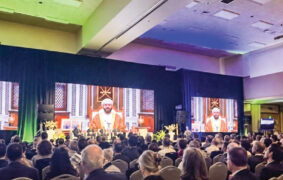

Muscat – Author Jokha al Harthi celebrated the release of the Italian translation of her award-winning novel Celestial Bodies at Bait al Zubair on Monday evening. The event, organised by the Italian Embassy and Bait al Zubair, included a talk between Jokha and the book’s translator Giacomo Longhi.
“I was so happy when my book was translated into Italian. I am a big fan of Italian culture and Italian authors. I grew up reading Italian authors such as Alberto Moravia and Umberto Eco,” Jokha said.
After a trip to Italy she discovered that her publisher – Bompiani – also published the works of Moravia and Eco. “I thought to myself: that is all I aspire to be part of!” she added.
Expressing his enthusiasm for the project, Longhi said, “I think the Italian people really loved the book, and Oman is really new for the Italian reader. It is the first Omani novel translated into Italian. Omani culture, I think, is something Italian readers could find themselves very well in.”
He also shared some of the challenges he faced while translating the book. “The process was interesting because it was the first time I worked on a novel about a country I had not visited,” he said.
“The poetry in the novel was a big challenge, and there are many poems in the books, all very different from each other. For example, classical poems and poems of Omani poets from the 19th century,” said Longhi.
At the book release event, a discussion was also held on the role of literature in representing communities, cultures and countries.
While Jokha finds joy in introducing Oman and Omani culture to a global audience, she warned that literature does not necessarily reflect reality. “The relationship between reality and imagination in the novel is thorny and complex because literature is not a mirror of reality. And if it is a mirror, it will be an uneven mirror, like mirrors found in carnivals,” she said.
Instead, Jokha urges readers to enjoy novels for what they are. “Oftentimes, especially in the West, Arab literature is (viewed) as social documents,” she noted. She believes that other forms of non-fiction texts are better suited to reflect the reality of a country.
When asked for advice she would give new writers, Jokha said, “It is the classic advice that we share with writers: read a lot and try a lot. Because without trying, and if we believe that the first text we ever write is the greatest text ever, we will not progress. In truth, we must toil and suffer for the sake of good writing.”
The event was the grand finale of the 22nd Italian Language Week hosted by the Italian Embassy in Oman. The annual initiative, promoted by the Italian Ministry of Foreign Affairs, aims to promote Italian language and culture abroad.
(Contributed by Hibba al Kindi)
© 2021 Apex Press and Publishing. All Rights Reserved. Powered by Mesdac