 By OUR CORRESPONDENT
Salalah – Oman is testing whether the dense fog that blankets Dhofar’s mountains during the khareef can be turned into a viable source of water, deploying a network of collection stations to measure how much moisture can be captured from the atmosphere.
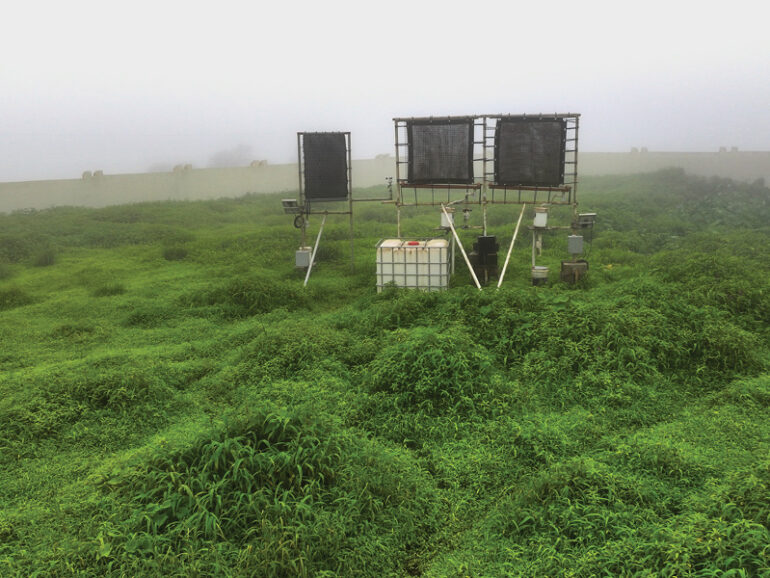
The Ministry of Agriculture, Fisheries and Water Resources has installed 12 fog-catching stations across nine locations in the governorate to collect data on condensation rates, water yields and the climatic conditions that influence fog formation.
The project is aimed at assessing fog harvesting as an unconventional water source and identifying areas where the technology could potentially be deployed on a larger scale.
Unlike cloud seeding, which attempts to enhance precipitation from suitable clouds, fog harvesting does not create or increase rainfall. It captures tiny water droplets already suspended in fog and converts them into water that can be collected and potentially used.
Khalid bin Salem Al Houti, Director of the Artificial Rainmaking Centre at the ministry, said the technology has relatively low energy requirements and could therefore merit wider use in areas where fog occurs frequently.
Dhofar’s mountains experience extensive fog and low cloud during the annual khareef season, making the region a natural testing ground for the technology.
The stations are not being used solely to collect water. They are also recording climatic and topographical information to determine how location, terrain and weather conditions affect the quantity of water that can be harvested.
Al Houti said the data collected during the khareef would be used to build a detailed scientific database and assess the technical feasibility of future fog-harvesting installations.
Researchers will use spatial modelling and statistical analysis to develop a predictive model capable of identifying locations with the greatest potential for extracting water from fog.
The approach could allow future collection facilities to be concentrated in areas where atmospheric and geographical conditions provide the highest yields.
Al Houti said the project’s importance extends beyond the immediate quantity of water collected. Understanding how fog behaves across Dhofar and determining its water potential, he said, could provide policymakers with reliable field data when considering alternative water resources.
Oman has been exploring non-traditional water sources as it seeks to improve water security and reduce pressure on conventional supplies.
The Dhofar project forms part of those efforts, combining atmospheric monitoring, field trials and data modelling to determine whether a natural phenomenon long associated with the governorate’s khareef can also contribute to its future water supply.
© 2021 Apex Press and Publishing. All Rights Reserved. Powered by Mesdac