 By OUR CORRESPONDENT
Muscat – The Ministry of Finance on Thursday announced the State’s General Budget for the fiscal year 2026, placing strong emphasis on social sectors, development projects and economic transformation, while maintaining fiscal discipline and continuing efforts to reduce the budget deficit.
Total public spending for 2026 is projected at RO11.977bn, reflecting a 1.5% increase over the approved 2025 budget. Nearly half of the expenditure has been earmarked for the social sector and basic services, underscoring the government’s focus on supporting citizens and sustaining essential public services.
The 2026 budget estimates current expenditure at RO8.771bn, marking a 2.5% increase compared to the 2025 budget. Current expenditure accounts for 73% of the total public expenditure.
Of the total current expenditure, defence and security spending is estimated at RO3.160bn, reflecting a 3% increase from RO3.070bn approved in the 2025 budget.
Expenditure of civil ministries and government units is projected at RO4.700bn, also reflecting a 3% increase from the previous year. The rise is attributed to periodic employee allowances, financial requirements to implement government programmes and objectives, and the settlement of outstanding dues owed to private-sector companies.
The 2026 budget allocates RO1.300bn for development projects and programmes approved within the budgets of civil ministries and government units. These include RO900mn for development expenditure of civil ministries and government units, and RO400mn for economic transformation projects. The allocation aims to stimulate economic growth through projects and programmes that contribute to national economic development.
Contributions and other expenses are estimated at RO1.906bn, accounting for 16% of the total public expenditure. These include subsidies for the water and sewage sector (RO170mn), electricity sector (RO509mn), social protection (RO614mn), waste sector (RO71mn), development and housing loan interest (RO75mn), food items (RO15mn) and the transport sector (RO82mn).
Public revenue for 2026 is estimated at RO11.447bn, marking a 2.4% increase from RO11.180bn approved in the 2025 budget.
Of the total public revenues, net oil revenue is projected at RO5.752bn, reflecting a 1.3% decrease from the previous year, while net gas revenue is estimated at RO1.961bn, representing a 10.4% increase from 2025 estimates.
Non-hydrocarbon revenue is estimated to reach RO3.734bn, a 4.5% increase from RO3.573bn approved in the 2025 budget. The growth is attributed to improved efficiency in tax collection by the Tax Authority, which is expected to enhance tax revenues and narrow the tax gap, alongside higher fee revenues driven by economic recovery.
Current revenue is projected at RO3.607bn in 2026, up 2.5% from 2025. This includes RO735mn from VAT and excise tax, RO684mn from corporate income tax, RO800mn in dividends from Oman Investment Authority, and RO1.388bn from government service fees.
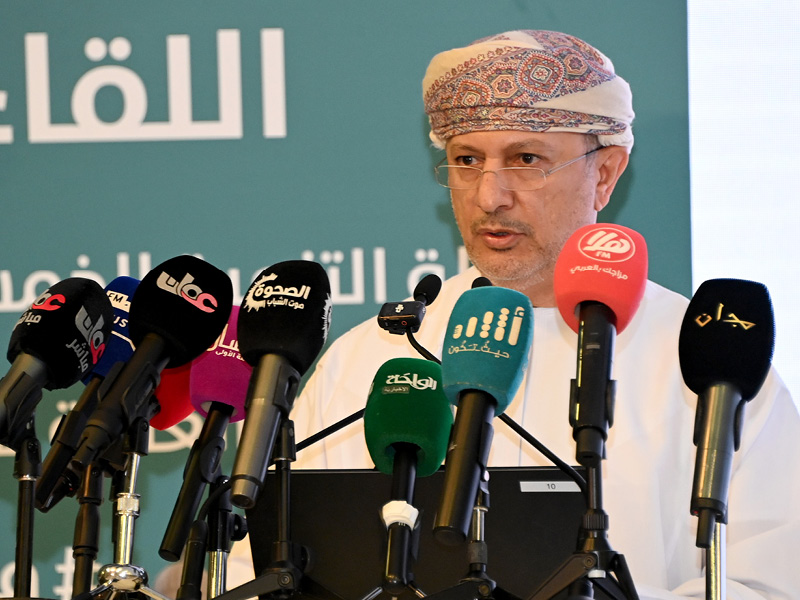
Addressing a press conference on Thursday to announce the details of the 2026 budget and the 11th Five-Year Plan, H E Sultan Salim al Habsi, Minister of Finance, said Oman has witnessed tangible improvements in its social, financial and economic indicators. “These improvements were driven by the recovery in global oil prices and government policies aimed at enhancing fiscal sustainability. The fiscal breakeven oil price has declined from over US$100 per barrel before the 10th Five-Year Plan to around US$68 per barrel in 2025, with continued efforts to reduce it further to mitigate financial shock risks.”
The 2026 budget is projected to record a deficit of RO530mn, representing a 14.5% reduction compared to the deficit approved in the 2025 budget. The projected deficit constitutes 4.6% of total public revenue.
To cover the shortfall, assuming an average oil price of US$60 per barrel, the government plans to finance the deficit through a mix of domestic and external borrowing, targeting net borrowing of RO130mn, along with a withdrawal of RO400mn from reserves.
H E Habsi said that any additional revenues generated from higher oil prices during the year would be used to cover the estimated deficit of RO530mn and to repay due loan instalments.
© 2021 Apex Press and Publishing. All Rights Reserved. Powered by Mesdac