 By MOHAMMED TAHA
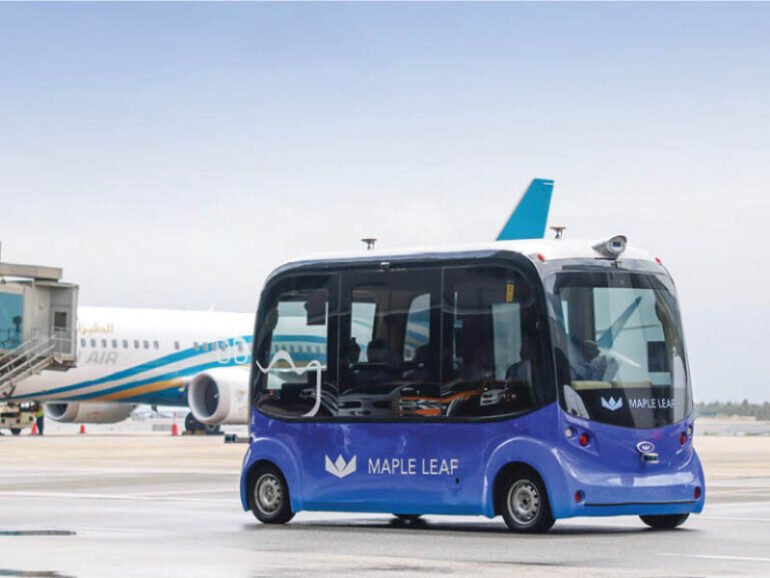
Muscat – Oman is moving towards wider testing of autonomous electric vehicles (EV) after an operational trial at Salalah Airport provided an opportunity to assess the technology in a real-world environment.
The trial assessed the vehicle’s ability to navigate using sensing systems, real-time monitoring and route identification while responding to surrounding conditions and obstacles, according to Abdullah bin Ali Al Busaidi, Director General of the Oman Logistics Centre and net zero expert at the Ministry of Transport, Communications and Information Technology.
Speaking to Muscat Daily after the trial, Al Busaidi said the results would help determine the technology’s readiness before moving to broader applications.
“The operational trial at Salalah Airport demonstrated the success of the autonomous EV in a real operational environment,” he said.
The current stage is focused on evaluating system efficiency and readiness. Further trials will involve testing vehicles under different conditions and in different environments, assessing safety and reliability, and evaluating communication and sensing systems.
These assessments will be undertaken alongside work to complete the regulatory and operational requirements needed for wider deployment.
Al Busaidi said it was still too early to determine the level of investment required for nationwide expansion, as the project remains in the trial, technical evaluation and operating-model assessment phase.

Oman is, however, looking at a model that would encourage participation from the private sector, local operators, logistics companies, autonomous-driving technology developers and specialised international firms.
Such participation could support technology and knowledge transfer, reduce initial investment risks and create opportunities in areas including vehicle operations and maintenance, software, artificial intelligence and fleet management.
The deployment of autonomous EVs could improve delivery efficiency and reliability while reducing some operating costs, particularly in last-mile applications and services involving frequent journeys along defined routes.
It could also help reduce emissions associated with conventional delivery operations.
Al Busaidi cautioned against putting a specific figure on potential savings or emissions reductions at this stage.
He said reliable estimates would require actual operational data covering the number of journeys, distances travelled, energy consumption, operating and maintenance costs, and the conventional vehicles that could eventually be replaced.
The results will be used to develop a more detailed economic and environmental feasibility assessment before any wider commercial expansion.
Oman is also working on the regulatory and technical requirements governing smart, connected and autonomous vehicles.
Full operation on public roads would require an integrated framework covering vehicle and operator licensing, safety standards, insurance, cybersecurity, data exchange, testing and operating requirements, and legal liability.
Al Busaidi said these requirements would need to be completed as the country progresses from controlled trials towards wider operations.
While logistics applications are the initial focus, the technology could eventually be considered for other uses.
As autonomous systems mature and the regulatory framework develops, potential applications could include transport within controlled areas, airports and complexes, followed at a later stage by passenger transport and shared mobility services within cities.
Al Busaidi said Dhofar had strong potential to become an advanced testing environment for smart and sustainable mobility.
The Salalah Airport trial represents one practical step in this direction, while Dhofar’s varied operating environments could provide opportunities to test different technologies before these are considered for wider deployment across Oman.
“The long-term objective is not only to import and operate the technology, but to build a local ecosystem for testing and development, attract companies and investment, transfer knowledge and develop national expertise,” Al Busaidi said.
The approach could help Oman develop local capabilities while supporting the wider adoption of smart and sustainable transport technologies.
© 2021 Apex Press and Publishing. All Rights Reserved. Powered by Mesdac