 By HUBERT VAZ
At LUMEN 2026, light becomes more than illumination – it becomes a way of questioning permanence, uncertainty, and the shifting relationship between what we see and what we understand
There is something fitting about beginning a conversation on permanence with light…
Light travels. It changes what we see, reveals what might otherwise remain hidden, and shifts constantly with our perception. Yet one of its most fundamental properties is presented to us as an absolute – the speed of light in a vacuum remains constant, regardless of where or how it is measured.
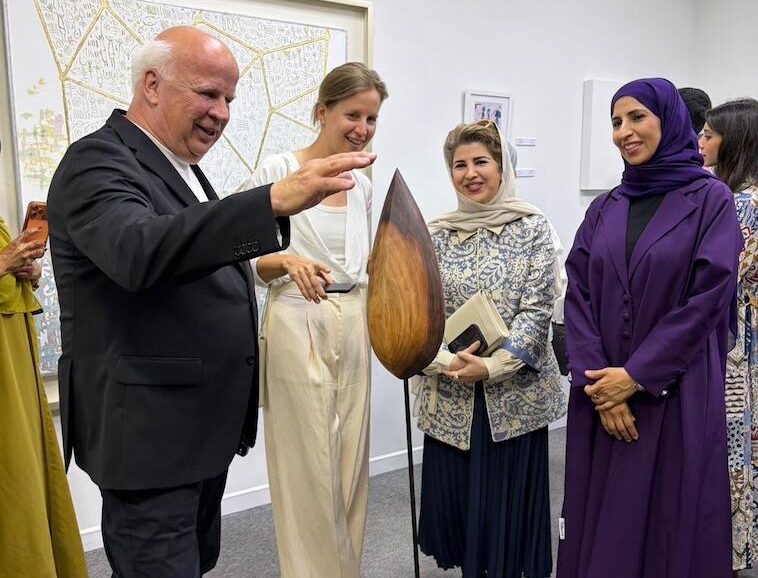
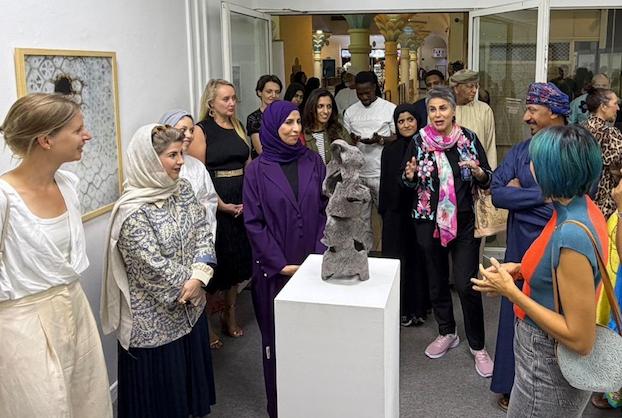
Step into Matti Sirvio Art Galleria and the idea of light quickly begins to feel less certain than it sounds. On Wednesday evening, LUMEN 2026 brought together paintings, sculptures, installations, prints and photographs that turned a seemingly immutable fact – the absolute speed of light – into a meditation on a world where almost everything else is in motion.
It was this intriguing tension between the constant and the changing that shaped the mood of LUMEN 2026, the contemporary art exhibition that opened at Matti Sirvio Art Galleria on September 2.
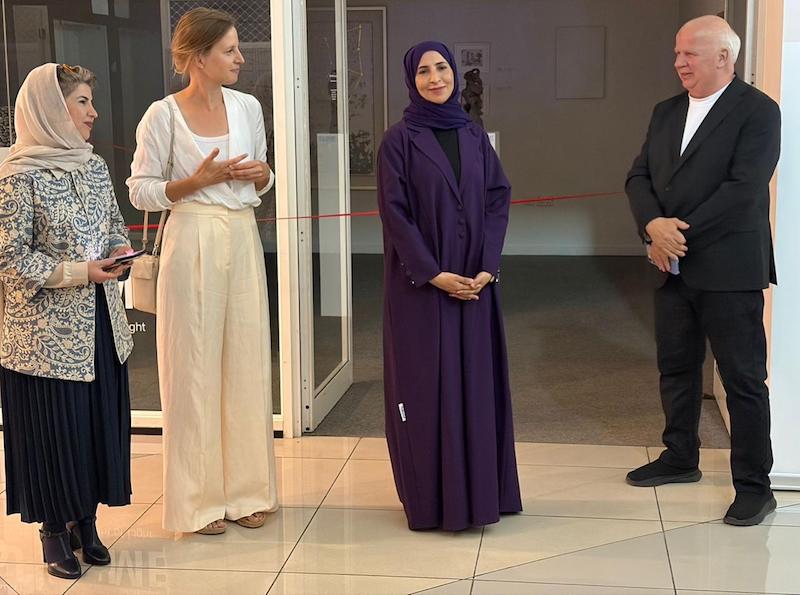
Hosted by Matti Sirvio Art Galleria and curated by Anetta Szabo, the exhibition brought together 14 artists working across installations, sculpture, painting, etching, print and photography. The opening was attended by Amina Nasser Al Balushi, Head of the Madad Cultural Salon, who was the guest of honour.
Rather than presenting light simply as a visual phenomenon, LUMEN 2026 uses it as a point of departure for a much larger reflection – what it means to look for something stable in a world that is continually shifting.
The question is deceptively simple. Humanity has long searched for fixed points – something reliable enough to stand upon, something enduring enough to trust. Yet, contemporary life often seems to offer precisely the opposite: uncertainty, movement and constant transformation.
The exhibition places these opposing ideas alongside one another -permanence and transformation, stability and uncertainty, the measurable and the elusive – and allows contemporary art to do what it often does best, leave the question open.
That openness is central to the way art lecturer and researcher Ghazaleh Beirami approaches the exhibition.
Reflecting on the works, Beirami draws on the thinking of German philosopher Hans-Georg Gadamer, for whom understanding is never something completed once and for all. Instead, it develops through dialogue. An artwork, in this sense, does not simply deliver a message from artist to viewer. It begins a conversation.
That makes the viewer an important participant in LUMEN 2026.
Walking through an exhibition such as this, one is not necessarily expected to arrive at a single conclusion about what the works mean or how they relate to the theme. The experience can be more personal and less predictable.
One work may suggest order to one viewer and uncertainty to another. A form that appears fixed may evoke movement; an image that seems immediately familiar may raise questions when viewed in the context of the exhibition as a whole.
“This ambiguity is particularly relevant to contemporary art in Oman,” Beirami suggests, “where the relationship between contemporary artistic practice, society and its audiences continues to develop.”
In that context, the gallery becomes more than a room in which artworks are displayed. It becomes a place for questions, for looking, interpreting, discussing and, perhaps, reconsidering what we thought we understood.
LUMEN itself has been exploring different dimensions of light in previous editions. Earlier exhibitions have considered light through its dual scientific nature as both particle and wave, as well as through its sensory and poetic qualities, particularly the vibrant colours and visual experiences associated with Oman.
For 2026, however, the starting point is different. The focus on the speed of light introduces the idea of constancy, but the exhibition does not remain confined to physics. Instead, the scientific premise opens a door into human experience. If there is something in the universe that can be described as constant, what happens when we place that idea beside lives that are anything but constant?
Beirami takes the thought a step further. For her, LUMEN 2026 is not merely about what remains unchanged, it is also about how our perception of the supposedly constant can itself change.
This is where the exhibition becomes particularly interesting. We may look at the same artwork twice and not quite see the same thing. We bring our memories, experiences and assumptions into the encounter. The meaning of a work can shift according to the person looking at it, the cultural setting in which it is displayed and even the moment in which it is encountered, she asserts.
Beirami connects this idea to Roland Barthes and his influential essay The Death of the Author, particularly Barthes’ argument that the emergence of the reader comes at the expense of the author’s authority over meaning.
Transferred from literature into visual art, the proposition is compelling – once an artwork leaves the artist’s studio and enters the world, its meaning is no longer entirely under the artist’s control.
The artwork travels. It moves across time, geography and culture. It meets different viewers and, with each encounter, can acquire another layer of meaning.
That possibility gives LUMEN 2026 an appealing openness. The artists may have created individual works, and the curator has brought them together under a carefully considered conceptual framework, but the exhibition ultimately depends on what happens when the audience enters the conversation.
The 14 participating artists include Khadija Al Maamari, Mohammed Khalifa, Majid Al Amri, Shima Amia, Sara Al Harrasi, Dr Ayman Elsadek Aly El Semar, Dana Al Jouder, Anetta Szabo, Amal Al Amiri, Faisal Al Abri, James Wagstaff, Wadhah Al Rashdi, Humaid Al Aufi and Rayan Balkhair.
The participating artists approached the exhibition through different artistic practices. The range of media itself reinforces the idea that there is no single way of seeing or expressing the relationship between permanence and change. And perhaps, that is the most productive tension within LUMEN 2026.
The exhibition begins with something presented as absolute – the speed of light – but ends somewhere much less certain, with the viewer. What remains constant may, in fact, remain constant. But our position in relation to it does not.
And so, the final question posed by LUMEN 2026 may not be about whether something is permanent at all… It may be about whether permanence can ever be experienced in exactly the same way twice.
© 2021 Apex Press and Publishing. All Rights Reserved. Powered by Mesdac