 By OUR CORRESPONDENT
Muscat – A study led by an Omani researcher at Sultan Qaboos University has developed a new class of compounds that demonstrated promising activity against cancer cells, while also showing potential anti-fungal and anti-bacterial properties.
The research, conducted by Dr Anwaar Said Al Maqbali, Assistant Professor at Sultan Qaboos University, focused on the synthesis and analysis of a group of biologically active molecules that could contribute to future drug development.
According to the study, selected compounds displayed strong activity when tested across 60 cancer cell lines, with some showing particular effectiveness against leukaemia cells. Researchers also observed encouraging antimicrobial properties, suggesting potential applications across multiple therapeutic areas.
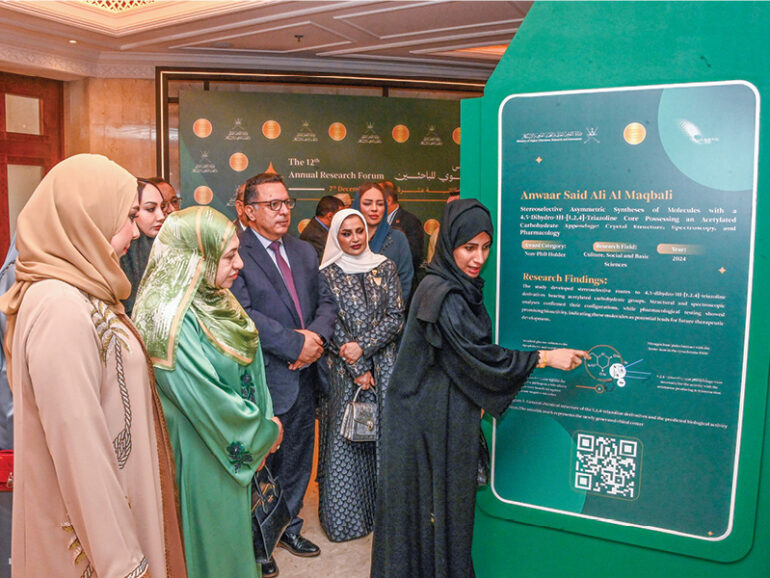
The study, titled ‘Stereoselective Asymmetric Syntheses of Molecules with a 4,5-Dihydro-1H-[1,2,4]-Triazoline Core Possessing an Acetylated Carbohydrate Appendage: Crystal Structure, Spectroscopy, and Pharmacology’, was recognised at the 12th National Research Award organised by the Research and Innovation Authority. It won in the Culture, Social and Basic Sciences category for young researchers.
Dr Anwaar and her team successfully synthesised a new series of chiral triazoline compounds using a chemical technique known as 1,3-dipolar cycloaddition. The compounds incorporate carbohydrate-based components, which researchers believe may enhance their biological relevance.
To verify the structure and properties of the molecules, the team employed advanced analytical methods, including high-resolution mass spectrometry, nuclear magnetic resonance spectroscopy and single-crystal X-ray analysis.
These techniques enabled researchers to map the compounds’ three-dimensional structures and better understand how they interact at the molecular level.
Dr Anwaar said the findings establish a reliable pathway for producing triazoline-based compounds that could serve as candidates for future therapeutic applications.
She called for further biological testing across a broader range of disease targets and more detailed studies examining how variations in molecular structure affect biological performance.
The research also highlighted the importance of stereochemistry – the three-dimensional arrangement of atoms within a molecule – in influencing the effectiveness of potential medicines.
The findings have been published in the international scientific journal Molecules.
Commenting on the recognition, Dr Anwaar said, “Winning the National Research Award is a prestigious recognition that validates my research efforts and motivates me to continue contributing impactful, high-quality scientific work that benefits both academia and society.”
© 2021 Apex Press and Publishing. All Rights Reserved. Powered by Mesdac