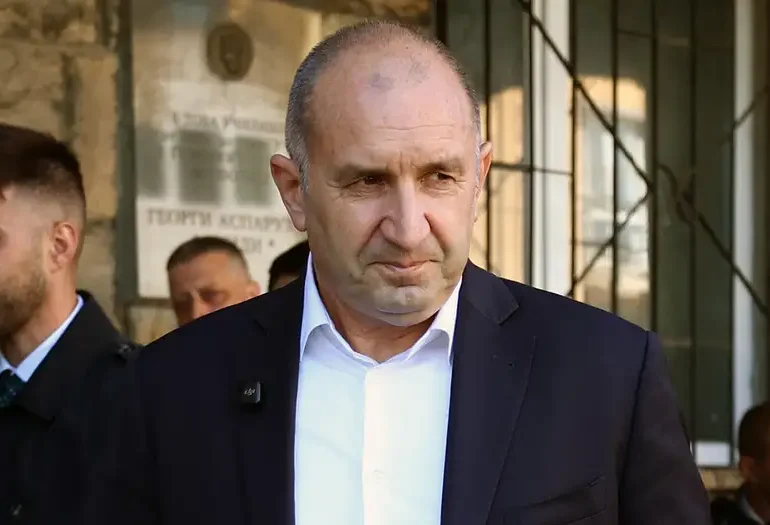
With a sweeping victory and a clear majority for former President Rumen Radev and diminished support for established parties, the result of Bulgaria’s eighth parliamentary election in five years is set to redraw the country’s political map.
Defying pre-election polls that predicted yet another potential coalition government, Rumen Radev’s Progressive Bulgaria stands at 44.7% of the vote, with 96% of the ballots officially counted.
This would give the party an absolute majority in parliament – the first political force to achieve this on its own since 1997.
The result raises expectations of an end to the country’s cycle of short-lived coalition governments, as Radev pledges to crack down on corruption, tackle inflation and pursue a more independent foreign policy within the EU – one that does not exclude dialogue with Russia.
“Progressive Bulgaria has won decisively. This is a victory of hope over mistrust, a victory of freedom over fear,” Radev said following the release of the first parallel count results, adding that ‘The people rejected the complacency and arrogance of the old parties and did not succumb to lies and manipulation’.
Established parties lag far behind
With 96% of votes counted, the runaway victory of Progressive Bulgaria has already brought major change: Just five parties are set to enter parliament compared with nine after the last election.
The official members of the previous coalition – GERB, the Bulgarian Socialist Party and the There is Such a People party – were punished severely by voters.
The centre-right GERB party led by three-time Prime Minister Boyko Borissov, has for the first time in its history dropped below 20%. It currently stands at 13.4%, putting it in second place and just narrowly ahead of the opposition liberal PP-DB party, which got 12.8% of the vote.
This major political shift follows last December’s mass protests against Borissov and Delyan Peevski, the leader of the DPS party, which supported the previous government without formally being part of it and was accused of pulling the strings from behind the scenes.
Protesters accused both men of being the main enablers of corruption in the country. The US and UK have imposed sanctions on Peevski for alleged corruption.
DPS currently stands at 6.6%, down from 11.5% in 2024. There is Such a People got less than 1%.
Widespread vote buying
After polling stations closed, the Bulgarian Interior Ministry announced that DPS and GERB ranked first and second in official reports of vote-buying, generating 631 and 318 reports respectively.
The runup to the election was marked by a large-scale crackdown on vote buying. The Interior Ministry has said that it seized over €1.2mn (US$1.41mn) earmarked for buying votes and detained over 370 suspected vote buyers.
“I am convinced that what has been seized is only a very small part of the whole,” Interior Minister Emil Dechev told DW, adding ‘we have about 50 individuals with immunity who are participating in the elections and for whom we have evidence of involvement in election crimes’.
Socialists not in parliament
For the first time since the first democratic elections in post-communist Bulgaria in 1990, the Bulgarian Socialist Party (BSP), which was part of the previous coalition government, failed to enter parliament, falling below the 4% threshold.
The BSP was the political force behind Radev’s rise to prominence and his first presidential bid.
Its core voters switched camps and supported Radev, who also attracted voters from the far-right pro-Russian Revival party.
Although Revival’s support fell sharply, dropping from 13.3% in 2024 to 4.3%, according to the official count, it is still set to enter parliament.
Radev faces major challenges
Radev’s in-tray is very full, and experts say he will have to hit the ground running.
Two top priorities will be the passing of a budget for 2026 – the first since Bulgaria joined the eurozone on January 1 – and the introduction of measures to combat inflation linked to the war in the Middle East.
“I think that there are two big expectations in our society: one for justice and the question of judicial reform. The second one is for stability,” said Antony Todorov, political science professor at New Bulgarian University on Bulgarian National Television.
While Radev is projected to win a clear majority of 130-132 MPs in the 240-seat parliament, he will need the support of other parties for any key judicial or constitutional changes that require a two-thirds majority (160 seats).
DW
© 2021 Apex Press and Publishing. All Rights Reserved. Powered by Mesdac