 By MUSCAT DAILY CORRESPONDENT
Belarus – The National Museum has opened “The Splendour of Silver: Treasures from the Omani Court” at the Grodno State Museum of the History of Religion in Belarus, marking the exhibition’s third stop in the country.
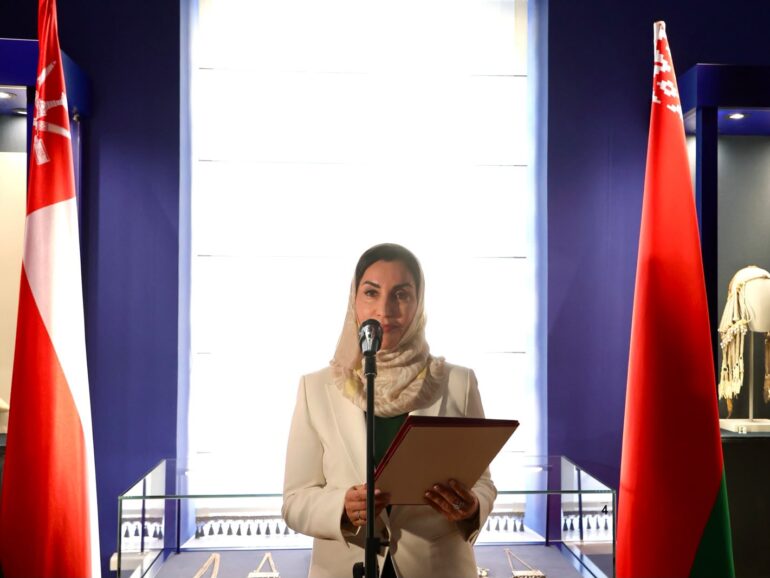
The exhibition was inaugurated on Friday, September 18, under the patronage of H H Sayyida Dr Mona bint Fahd Al Said, Assistant President of Sultan Qaboos University for International Cooperation and Vice-Chairperson of the Board of Trustees of the National Museum.
The opening was attended by Yuri Khadzhimuratovich Karaev, Chairman of the Grodno Regional Executive Committee, as well as officials and representatives of the cultural and museum sectors in Belarus.
The exhibition, which runs until November 20, showcases a carefully selected collection of Omani silver objects associated with the Sultans of Oman in Muscat and Zanzibar. It highlights silver as an important traditional craft and its role in Oman’s cultural, social and court heritage.
The exhibition’s first Belarusian stop was at the National Art Museum of the Republic of Belarus in Minsk in December 2025. It then moved to the Vitebsk Regional Museum of Local Lore in July 2026 as part of the International Arts Festival “Slavianski Bazaar in Vitebsk”.
The exhibition is organised into five main sections: the Omani khanjar; the Culture of Fragrance; the Art of Silver-Making; Traditional Dress; and Elite Attire of Prominent Omani Figures in East Africa.
Khanjar and court heritage
The Omani khanjar section traces the history and development of the traditional dagger and highlights its symbolism as an integral element of Oman’s national emblem.
It features different types of Omani khanjars and their accessories, including the Sa‘idi khanjar associated with the Al Said ruling family, as well as Nazwani and Suri khanjars.
The collection also includes a janbiya presented by Ali Abdullah Saleh, former President of Yemen, to the late Sultan Qaboos bin Said.
Fragrance and craftsmanship
The Culture of Fragrance section highlights the importance of perfumes and fine scents in Omani social and cultural life.
Among the exhibits are rare perfume bottles dating to 1983, made from crystal, 24-carat gold and silver. They represent the first fragrance creations of Amouage under the name Amouage Gold.
The men’s perfume bottle was inspired by the Omani khanjar and was presented by the late Sultan Qaboos to his guests. It became known as the “Gift of Kings”.
The section also highlights natural ingredients including frankincense, rose and amber, with frankincense presented as an important element of Oman’s longstanding cultural and civilisational exchanges.
The Art of Silver-Making section explores the craftsmanship, aesthetic value and symbolic significance of silver objects. It also highlights their use in adornment and protection, as well as their social and economic importance for women, including as part of dowries and a form of financial security.
Traditional dress
The Traditional Dress section examines Omani clothing as an expression of identity, modesty, religious values and adornment.
It features components of traditional men’s and women’s dress, together with tools and weapons decorated with silver. Among the notable exhibits are a shield and a matchlock firearm from the private collection of His Majesty Sultan Haitham bin Tarik.
The final section, Elite Attire, presents clothing and jewellery belonging to prominent Omani figures and explores their role in documenting social and cultural life at the Omani court and in East Africa.
Among the exhibits are jewellery and a face mask (burqa‘) belonging to Sayyida Salma bint Said bin Sultan Al Busaidi, dating to the 13th century AH/19th century CE.
Museum with 67,000 artefacts
The Grodno State Museum of the History of Religion was established in 1977 and is the only specialised institution of its kind in Belarus.
The museum seeks to present the history and culture of peoples who have inhabited Belarus while promoting tolerance and respect for cultural and religious diversity.
Its collection is displayed across 13 exhibition halls and comprises approximately 67,000 artefacts and artworks organised into 14 museum collections.
The holdings include archaeological discoveries, decorative and applied arts dating from the 13th to the 20th centuries, engravings, old printed books and musical instruments. The museum also houses permanent exhibitions on ancient beliefs and the architectural history of the historic palace in which it is located.
© 2021 Apex Press and Publishing. All Rights Reserved. Powered by Mesdac