 By ANIRBAN RAY
Muscat – With centuries of maritime links behind them and a new trade framework opening fresh opportunities, Oman and India are looking to deepen a relationship that now stretches from energy and investment to technology, education, culture and space.
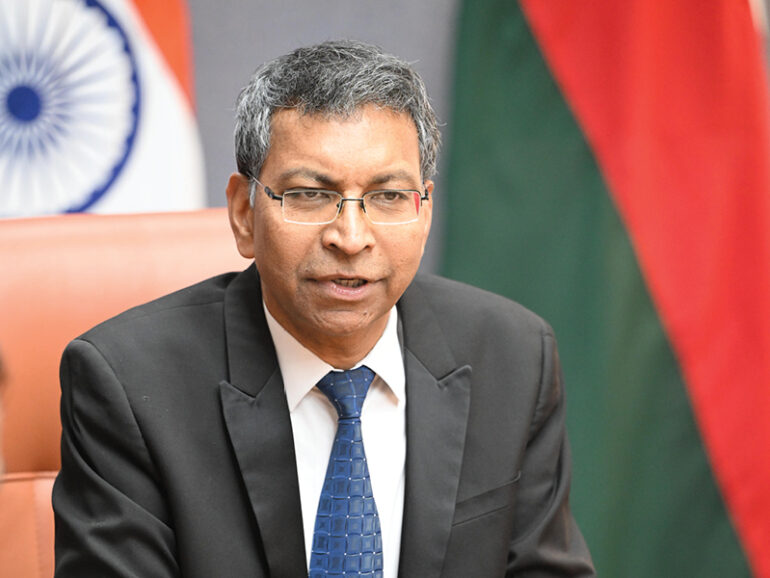
For H E Prashant Pise, India’s new Ambassador to Oman, implementing the Comprehensive Economic Partnership Agreement (CEPA) will be among his immediate priorities, alongside strengthening cultural and people-to-people ties.
In an interview with Muscat Daily, H E Pise outlined his plans for taking the strategic partnership forward. Excerpts:
Beyond the usual cultural and bilateral focus, what are your immediate priorities for expanding India-Oman relations?
Oman is a key strategic partner for India, and my priority is to take this partnership forward across all verticals. It is multidimensional, covering political and strategic engagement, maritime security, defence, culture, economic and technological cooperation, besides strong people-to-people ties.
A major priority is implementation of CEPA. Bilateral trade currently stands at around US$11bn, and we expect the agreement to increase this by 1.5 times or even double it.
With roughly 99% of tariff lines becoming tariff-free, our focus is on reaching out to businesses and stakeholders and highlighting opportunities in trade, investment, services and professional mobility.
Oman is only the second GCC country with which India has concluded a CEPA, while India is only the second country with which Oman has signed a free trade agreement.
How many visas are issued to Omani nationals travelling to India annually?
Omani nationals have access to India’s e-visa facility, allowing them to apply online from home and generally receive confirmation within 72 hours without visiting the embassy.
Around 6,000 to 7,000 Omanis apply physically at the embassy each year, while total visas issued, including e-visas, is between 65,000 and 70,000 annually.
Travel has been recovering steadily, driven mainly by medical treatment, business and tourism.
Which Indian destinations are most popular with Omani visitors?
Omanis travel widely across India. Leh and Ladakh are increasingly popular, as is the Golden Triangle of Delhi, Agra and Jaipur.
Hyderabad remains attractive because of longstanding cultural connections, while others visit India for wellness, yoga and heritage tourism.
Direct connectivity through IndiGo, Air India Express, Oman Air and SalamAir has also made travel easier.
Are there plans for more Indian schools in Oman?
We currently have 22 Indian schools serving around 50,000 students, supported by more than 2,000 faculty and staff.
Although they primarily follow the CBSE curriculum, the schools are diverse, with students from more than 40 nationalities.
The Indian School Board continuously assesses demand across Oman and will consider new schools wherever there is sufficient requirement.
What initiatives are planned to strengthen cultural and people-to-people links?
We have an active cultural exchange framework between our culture ministries. Given our shared maritime history, we are encouraging cooperation between national museums, cultural institutions and through naval ship visits.
Through the Indian Council for Cultural Relations, Omani students can receive full scholarships for undergraduate, postgraduate, PhD and fine arts programmes in India.
The Indian Technical and Economic Cooperation programme also provides specialised training for Omani government officials and business representatives.
Youth and sports exchanges are another important area. Recently, eight young Omani students visited India to experience our space facilities and learn about the Indian space programme. There is considerable curiosity among young people about space and technology.
How does the embassy support Indians living across Oman?
We have authorised representatives across Oman, including Suhar, Barka, Salalah and Musandam, so people in distant areas do not always need to travel to Muscat.
Documents can be submitted locally, processed by the embassy and returned by courier.
We also operate 24/7 emergency contacts in several Indian languages and have two dedicated lines for domestic workers.
For people in distress, particularly women, we can provide shelter, accommodation, food and medical support while facilitating their safe return to India.
The embassy also assists with repatriation of mortal remains when families face financial difficulties, often with support from the Indian community.
© 2021 Apex Press and Publishing. All Rights Reserved. Powered by Mesdac