 By MOHAMMED TAHA
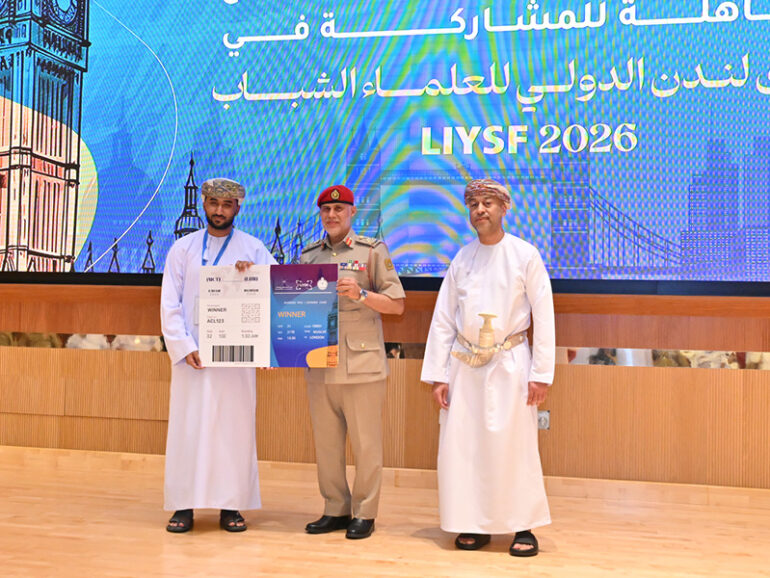
Muscat – From a university hackathon project to a technology with international potential, an artificial intelligence system designed to detect and prevent water pipeline failures will represent Oman at the 67th London International Youth Science Forum (LIYSF) in the United Kingdom from July 19 to August 1.
The system, named ThermoLeak AI, has been developed by Rashid Al Shekaili, a third-year Mechanical Engineering student at the German University of Technology in Oman (GUtech). It uses artificial intelligence to continuously monitor water transmission pipelines and detect early warning indicators of possible failures, allowing operators to intervene before leaks occur.
The innovation seeks to address a persistent challenge faced by water utilities globally, where leakages in long transmission networks often go undetected until substantial volumes of water have been lost. By shifting from reactive detection to predictive monitoring, the system aims to improve efficiency and support more sustainable water management.
Al Shekaili said the concept originated during the Tahadi Mustdam Hackathon, organised by the British Council and hosted by GUtech, where his team developed a smart pipeline inspection idea and secured first place. The team later travelled to Edinburgh to represent Oman at an international youth event.
“That experience stayed with me. I kept developing the idea and refining it through various competitions and exhibitions over the course of a year until it evolved into what it is today,” he said.
He noted that the development process involved repeated redesigns and continuous experimentation.
“The biggest challenge has been the iterative nature of the process. The idea went through many versions across multiple hackathons and competitions, and each time we had to rethink and reshape the concept,” he said.
“That kind of constant refinement is intellectually demanding, but it also pushes the project to a much stronger place than where it started. Currently, our main challenge is data collection, which is essential for improving the system’s accuracy and reliability.”
Unlike conventional leak detection systems that identify failures after they occur, ThermoLeak AI analyses subtle variations in pipeline conditions that may signal emerging faults. The system is designed to provide early warnings to operators, reducing both water loss and the associated economic and environmental impact.
Al Shekaili said the innovation could be particularly relevant for countries such as Oman, where water conservation remains a strategic priority and efficient management of resources is critical. He noted that utilities and operators managing extensive transmission networks could be among the key beneficiaries.
He added that participation in the LIYSF would offer valuable exposure to global research approaches and development models.
“I am looking forward to being surrounded by young scientists and innovators from across the globe, learning how similar challenges are being approached elsewhere and bringing those insights back to my own work,” he said.
Encouraging young innovators, he urged persistence through uncertainty. “The right idea rarely arrives fully formed. It emerges through many attempts, failures and lessons. Trust the process,” he said.
© 2021 Apex Press and Publishing. All Rights Reserved. Powered by Mesdac