
 By OUR CORRESPONDENT
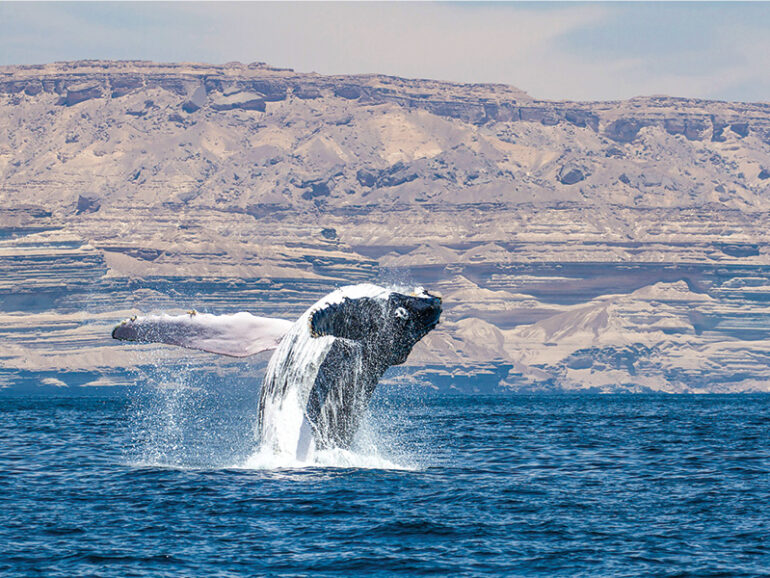
Muscat – For decades, Arabian Sea humpback whales have puzzled scientists. Unlike other humpback whale populations that migrate thousands of kilometres between feeding and breeding grounds, the endangered whales found off Oman’s coast are known for staying close to home. But one whale has now challenged that understanding.
Researchers tracking Arabian Sea humpback whales (ASHW) have documented the first direct evidence of a whale from the population travelling across the Arabian Sea to India, shedding new light on one of the world’s rarest marine mammals.
The study, published in Frontiers in Marine Science, followed the movements of 14 whales fitted with satellite tags in waters off Oman. Most remained within a limited range between the Gulf of Masirah, Hallaniyat Bay and parts of northern Yemen, confirming the population’s reputation for localised movements.
One whale, however, stood out. A female known as Luban, named after the frankincense-shaped marking on her tail, left Omani waters and travelled east across the Arabian Sea. Satellite data showed her reaching waters off Goa on India’s west coast before returning to Oman, completing a journey of about 7,000km.
Researchers said Luban’s voyage marks the first confirmed crossing of the Arabian Sea by an ASHW.
“We see ASHWs predominantly staying within a very restricted home range along the coast of Oman,” said Dr Andrew Willson, lead author of the study and founding director of Future Seas Global SPC. “Alongside very localised movements, we also document the first long-distance movement of an ASHW across the Arabian Sea.”
Scientists have long believed that ASHW, whose population is estimated at just over 80 animals off Oman, rarely venture far from regional waters. Previous links between whales off Oman and India had been based largely on similarities in whale songs recorded in both areas.
Luban’s journey now provides direct evidence that at least some individuals move between the two regions.
Researchers believe the highly productive waters off India’s southwest coast may have attracted the whale in search of food or breeding opportunities. She remained in the area for up to a month before making the return journey.
The whale has since been sighted again in the Gulf of Masirah, offering reassurance to scientists monitoring the small and endangered population.
“The Arabian Sea provides unique conditions allowing a once-migratory species to completely change its ecology. It’s a testament to how extraordinary the region is,” concluded co-author Suaad Al Harthi, Executive Director of Environment Society of Oman, the local research partner in the project. “We hope their adaptability will help ASHWs in uncertain times when their domain is influenced by accelerated climate change.”
© 2021 Apex Press and Publishing. All Rights Reserved. Powered by Mesdac