
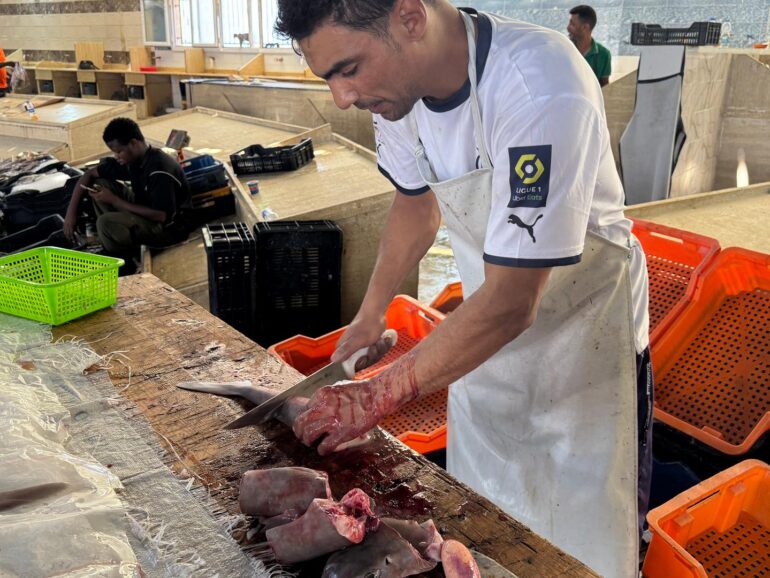
Tripoli, Libya – At a fish market in the Libyan capital of Tripoli, stallholders shout to attract customers to trays piled high with popular frozen seafood such as octopus, squid and shrimp.
But that’s not all that’s on display. Some trays contain sharks with their bellies still swollen with eggs. Among them are dozens of longnose spurdogs, known locally as ‘kalb al-bahr’, which have clearly been caught mid-breeding season.
One fisherman, who asked to remain anonymous for security reasons, said there is no monitoring at sea or at the point-of-sale in Libya.
And because ‘kalb al-bahr’ can be sold relatively cheaply, making it popular with local consumers, fishers trying to survive the country’s worst economic crisis in modern history ignore the restrictions on fishing during breeding seasons.
“We catch them even though we know they are carrying eggs,” he said. “We sell them in the market because they bring money.”
The species has a slow reproductive cycle, with females only producing one to six pups per pregnancy, so it’s highly vulnerable to sustained fishing pressure.
Community engagement
Longnose spurdogs are not the only species at risk. A 2021 study found that oceanic shark and ray populations have declined by 71% since 1970. IUCN data indicates that around 38% of shark and ray species are threatened with extinction.
Libyan waters are considered among the most important shark habitats in the region. When marine biologist Sara Al Mabruk found social media images of fishermen hauling the animals, including endangered species, from Libyan waters, she decided to take action.
Using social media herself, she reached out to fishermen and asked them to share photos and information about the species when they encountered them in their nets.
“We have achieved a lot through social media alone,” she told DW.
Gradually, her posts evolved into an awareness campaign, and her name became associated with shark conservation. She also uses local radio stations and meets fishers directly to explain the status of sharks in Libyan waters and why they require urgent protection.
“The moment I realised my efforts were making an impact was when a fisherman contacted me to say he had found a small pregnant shark and returned it to the sea,” she said, adding that she is confident that she can protect ‘endangered sharks in our waters’.
But Al Mabruk is less optimistic about the future of the longnose spurdogs, which is classified on the Red List of endangered species as ‘data deficient’, meaning there is not enough information to assess its risk.
“If the situation continues unchanged, further declines in its numbers are likely over the next decade,” she said.
She is concerned about the classification of the ‘kalb al-bahr’, and says other species initially listed in that category became designated as ‘threatened’ once more accurate data became available. It is ‘a scenario we do not want to discover too late’, she said. Not least because sharks play a critical role in the regulation of marine ecosystems.
Because sharks regulate mid-level predators, their decline can trigger imbalances in the food web. This can ultimately affect commercially important fish such as sardines and mullet, on which many coastal communities depend.
Protection on paper
The Marine Biology in Libya Society, a nongovernmental organisation, has documented 30 shark species in Libyan waters, noting that several are regularly caught and displayed for sale in markets.
Although Libya has a fisheries law dating back to 1989 that grants authorities the power to regulate seasons and fishing gear, it is not strictly enforced – and it is nearly impossible to implement offshore without compliance from the fishing fleet. It also does not include a list of prohibited species.
Regional coordination in terms of monitoring shared waters, data exchange and enforcing conservation measures is also limited.
DW
© 2021 Apex Press and Publishing. All Rights Reserved. Powered by Mesdac