 By
By
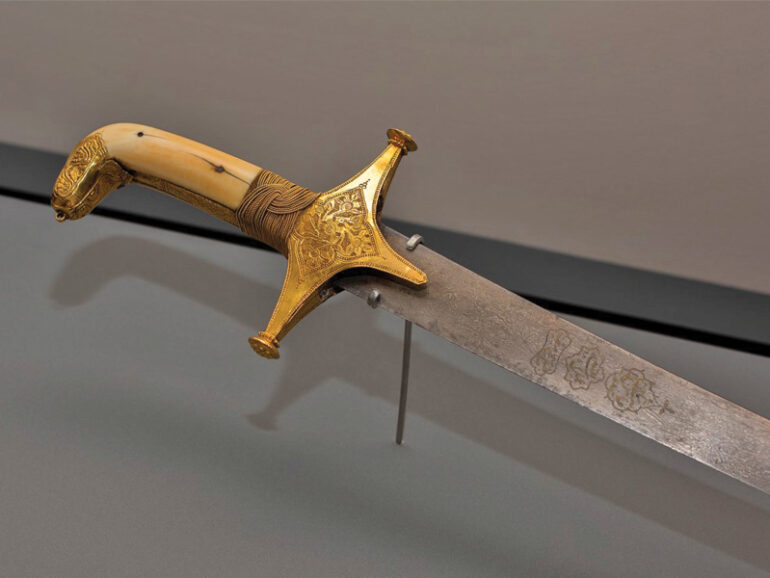
Muscat – The National Museum is displaying the sabre (shamshir) and the al-Haswah dagger (khanjar) of the Imam Saif bin Sultan al Yarubi from the collections of the late Sultan Qaboos bin Said.
The blade of the sabre, made of Damascus steel, is patterned with the most complex design, known as the ‘Forty steps’. The signature of the swordsmith appears in the middle on the blade marked – ‘the work of Asadallah 186’, which was made by Asadullah of Isfahan, one of the most celebrated swordsmiths of the Islamic civilisation in the 7th century CE.
Below the signature, the sabre has the phrase ‘property of Sheikh Saif’, and ‘Shah Abbas year 5’ engraved.
The handle is made of gold and ivory. ‘The ownership inscription on the blade proves that the sabre was not taken as a loot, instead it had been commissioned directly from the maker. From the designation, it seems likely that it was made for presentation to the Imam, perhaps by the Savavid Court of Persia, who in 1675, saw him as a future leader of Oman,’ stated a press release.
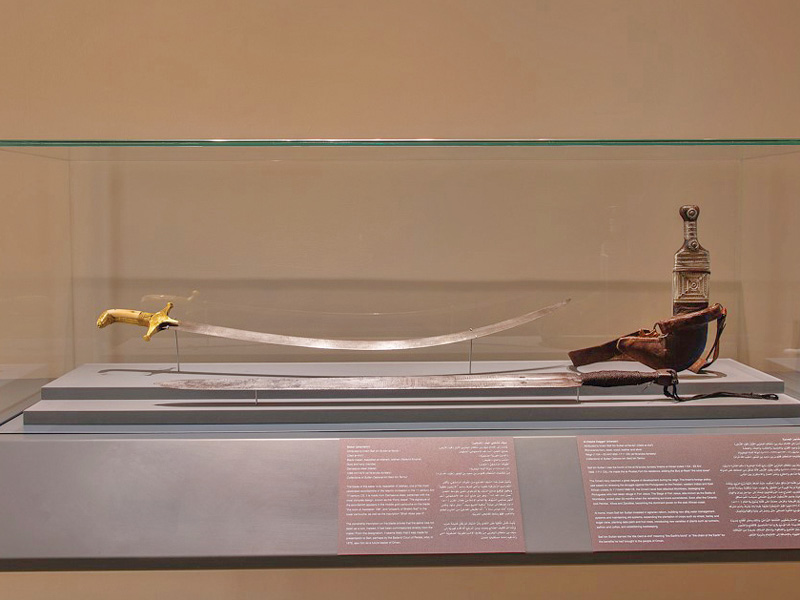
The al-Haswa dagger is made from rhinoceros horn, steel, wood, leather and silver and dates back to reign of the al-Ya’aruba dynasty between (1692-1711 CE).
The Omani navy reached a great degree of development during Imam Saif’s reign. The Imam’s foreign policy was based on renewing the struggle against the Portuguese on the Persian, western Indian and East African coasts.
In 1696 CE, the Omani naval fleet attacked Mombasa, besieging the Portuguese who had taken refuge in Fort Jesus. The Siege of Fort Jesus, also known as the Battle of Mombasa, ended after 33 months when the remaining survivors surrendered. Soon after the Omanis took Pemba , Kilwa and Zanzibar, becoming the
dominant power on the east African coast.
At home, Imam Saif bin Sultan invested in agrarian reform, building new aflaj water management systems and maintaining old systems, expanding the plantation of crops such as wheat, barley and sugar cane, planting date palm and fruit trees, introducing new varieties of plants such as turmeric, saffron and coffee, and establishing beekeeping.
© 2021 Apex Press and Publishing. All Rights Reserved. Powered by Mesdac