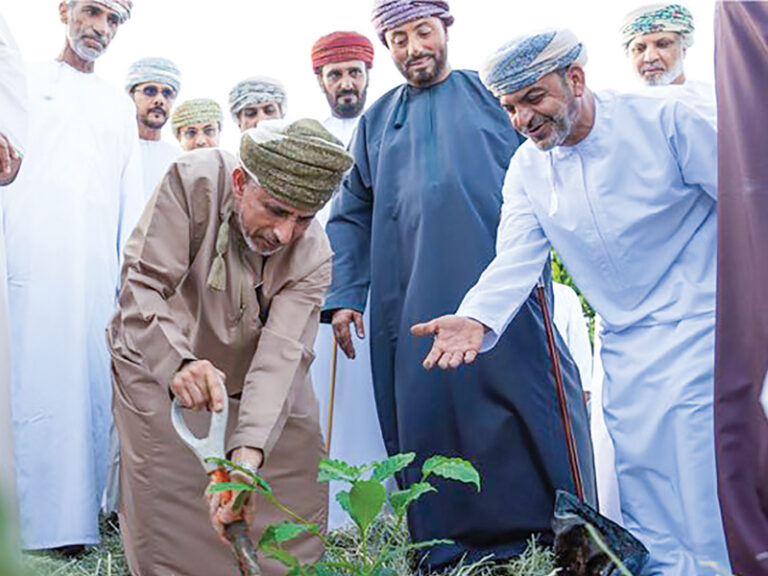
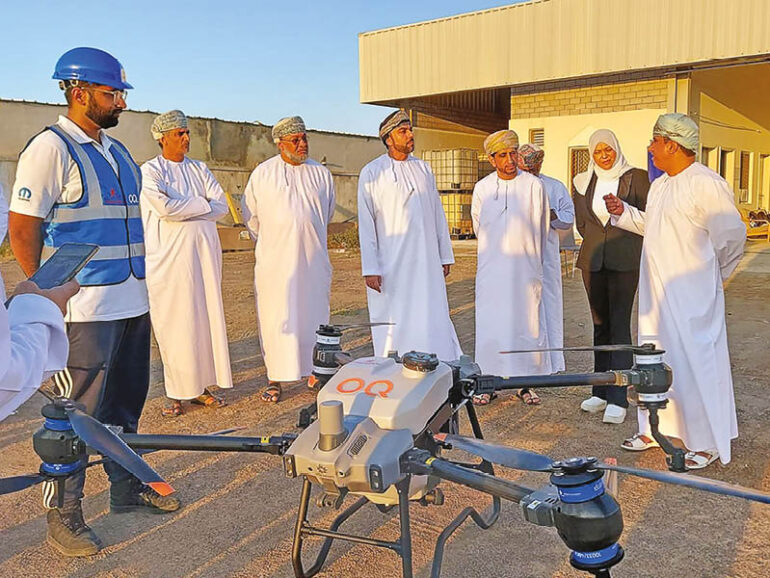
Muscat – The Ministry of Agriculture, Fisheries and Water Resources (MAFWR), in cooperation with OQ, has started using drones to spray pesticides in its combat against the spread of Dubas bug and red palm weevil in the wilayat of Barka.
Since mid-1980s, the red palm weevil and Dubas bug have been reported to cause serious damage to date palms in Oman and in the Gulf region.
The unique agroclimatic conditions prevailing in the Middle East and the nature of the crop, coupled with transportation of planting material, led to the rapid spread of the pest in a short period of time.
In a statement issued by MAFWR, it said that the ministry reviewed the results of the first phase of the aerial surveys by satellites and drones for the early detection of Dubas bug and the red palm weevil using spectral scanning technology, in the presence of H E Dr Ahmed bin Nasser al Bakri, Undersecretary for Agriculture in MAFWR.
The ministry wanted to develop better pesticide spraying techniques and aerial surveys for early detection of agricultural pests.
According to MAFWR, the experiment culminated in good preliminary results, following which, it decided to expand pesticide treatment in the next few months by ‘spraying larger areas using modern methods’ that the ministry assessed will contribute to raising the efficiency of spraying and overcoming some of the challenges in fighting the menace in the remote areas of Oman.
The ministry also revealed the results of an integrated management programme for the first half of 2022 to curb red palm weevil infestation.
The results showed an increase of 16.4 per cent in the number of pest infested palm trees across Oman. The number of infested trees was 22,444 against the 19,278 trees found infected last year.
Efforts of field teams and the ministry’s specialists led to the treatment of 18,213 palm trees, or 81.2 per cent of the total affected palms in H1 2022. ‘This is 14.3 per cent more than H1 2021, when 15,937 palm trees were treated,’ the ministry added.
In 2022, 4,231 infected date palms were felled, which is 18.9 per cent of the total infected palms, compared to the removal of 3,341 palms during the same period of 2021, representing 17.3 per cent of the total infected palms.
Field teams trapped 50,312 red palm weevil insects using 3,867 trapping devices in 2022, compared to 42,915 in 2021.
The ministry said economic losses to the date plantation sector were significant due to red palm weevil infestation this year. Infestation of 22,444 date palms led to a total loss of RO1.571mn, while treatment of 18,213 trees had cost RO1.274mn, while removal of 4,231 infected palms had cost the ministry RO296,170.
© 2021 Apex Press and Publishing. All Rights Reserved. Powered by Mesdac