 By HUBERT VAZ
As marine tourism brings growing numbers of people into the water, the desire to get closer to wildlife is increasingly turning observation into interference. For divers, snorkellers and photographers, the question is simple – where should we draw the line today? – says Paul Flandinette, an underwater photographer and filmmaker in Oman
Early in my diving life, a Spanish dancer came very close to me. Fascinated by the graceful undulations of this beautiful animal, I extended my hand. It wrapped its soft body around my forearm.
At the time, the encounter felt remarkable. Today, I remember it rather differently. I had entered the animal’s world and deliberately initiated contact without understanding what effect that contact might have. I don’t know whether I harmed it, but several decades later I still occasionally think about that moment – and regret putting out my hand.
Perhaps that experience is one reason I now feel so strongly about divers and snorkellers touching marine wildlife. Curiosity is understandable. Contact is not. We should not need to touch a wild animal to feel connected to it.
Why isn’t seeing enough?
Anyone who has spent time underwater will have witnessed it. A diver strokes a turtle’s shell. A snorkeller reaches for a whale shark as it passes. Someone picks up a starfish to show their dive buddy. A photographer moves an animal into a more convenient position or persists until it abandons what it was doing. Sometimes the contact is defended as harmless. Sometimes it is presented as affection.
But affection is not what the animal experiences. From its perspective, an unfamiliar creature has entered its habitat, approached it and made physical contact. The fact that it does not immediately flee is not permission. Nor does an animal’s apparent tolerance prove that no disturbance has occurred.
Why, then, is observation so often considered insufficient? Touch makes an experience feel more immediate and personal. A photograph provides proof that we did more than merely see the animal. Social media has intensified that urge, presenting physical interaction as exclusive, thrilling and shareable.
Touching can have consequences
Many marine animals possess delicate external defences. Fish and numerous other species have protective mucus layers that help shield them from pathogens and parasites in the water. Corals also possess a protective surface layer. Touching can damage or remove that protection. Fragile corals, already struggling to survive rising sea temperatures, can be broken by a careless hand, knee or fin.
The danger is not limited to visible injury. An animal can be disturbed without being physically harmed. A feeding turtle that turns away has lost feeding time. A resting animal forced to move expends energy unnecessarily. A whale shark repeatedly approached, crowded or touched may move away from a feeding area or abandon it altogether. One interruption may appear insignificant, but at heavily visited sites the same animal can be approached repeatedly throughout the day.
Accidental contact can happen even to careful divers, but there is a difference between a genuine accident and contact caused by poor buoyancy, inadequate awareness or a determination to get closer just for the thrill of it. Good diving is not simply the ability to remain underwater. It includes respect for marine life and knowing where our fins, equipment and bodies are in relation to the reef and its inhabitants. If we cannot maintain buoyancy control without striking coral or wildlife, we should move away until we can.
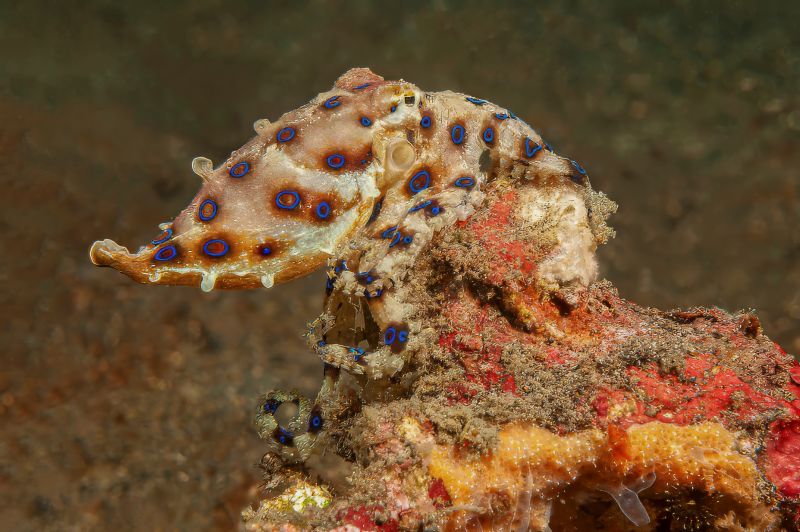
I recently watched what appeared to be a genuine video of a diver holding a blue-ringed octopus. The description marvelled at its beautiful blue rings. Those blue rings, however, were a warning: the animal felt threatened.
By picking it up, the diver had placed themselves in great danger. A blue-ringed octopus can deliver tetrodotoxin, a powerful neurotoxin that can cause rapid paralysis and respiratory failure. A single animal is estimated to carry enough venom to kill more than twenty adults. Yet the diver seemed unaware that the animal in their hand was communicating stress.
The photograph that is not worth taking
As an underwater photographer, I take great care to avoid direct contact with marine animals. In my opinion, no photograph, however unusual or potentially valuable, justifies interfering with the wildlife I am there to document.
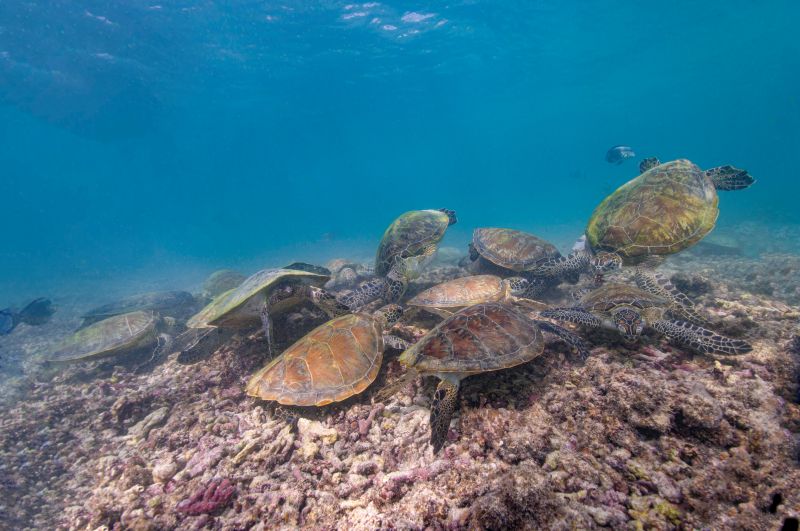
A particularly striking example is an unusual aggregation of green turtles at a site in Oman, where I’ve photographed them over several years. Sometimes as many as thirty gather in remarkably close proximity. They clamber over one another, their bodies frequently touching, and appear entirely unfazed by the contact.
They also seem untroubled by my presence. They do not necessarily move away while I am photographing them and may sometimes come extremely close. But their tolerance is not an invitation for me to touch them. I try to stay aware of where they are and, when one approaches too closely, I back off and then recheck the scene before re-engaging.
There is an important distinction here. Contact between the turtles is part of their natural behaviour; contact initiated by a photographer would be an intrusion. An animal choosing to approach us does not give us permission to reach out and touch it – tempting though that may be.
When an encounter is manufactured
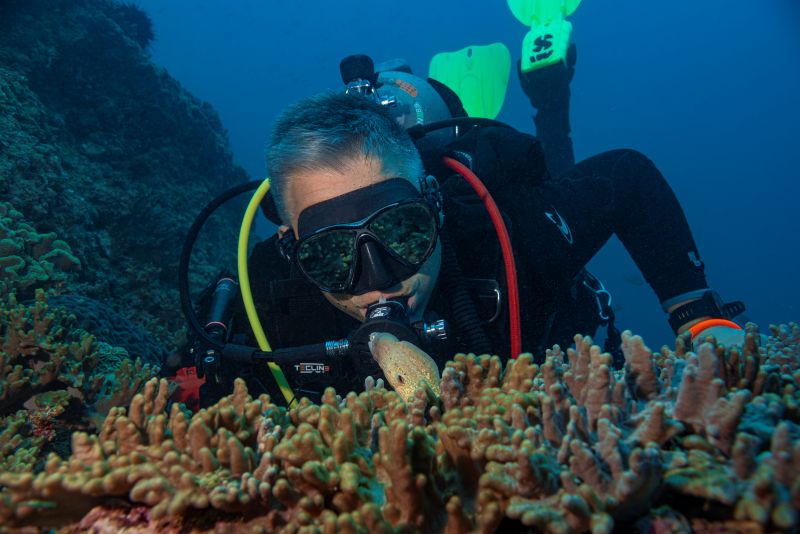
Properly managed, marine encounters can replace fear with understanding and create value for local communities. Shark tourism, for example, illustrates both the promise and the difficulty. Taking people into the water with sharks can build appreciation for animals feared and vilified for generations. Responsible encounters can make sharks more valuable alive than dead. But conservation value does not justify every practice.
Encounters that occur at natural aggregation sites require no feeding. Some operators use bait, scent or direct provisioning to draw sharks close to paying customers. There is a difference between observing wildlife behaving naturally and manipulating its behaviour to manufacture an encounter. Once food is introduced, the circumstances in which people and sharks meet are no longer entirely natural.
More troubling is the promotion of snorkelling with baited sharks. Participants may have limited experience in open water and be attracted principally by the promise of a thrilling encounter. At the surface, swimmers may struggle to keep track of sharks approaching from behind or beneath them. Frightened participants may splash or react unpredictably. Some operators are bringing inexperienced swimmers, sharks and food close to each other.
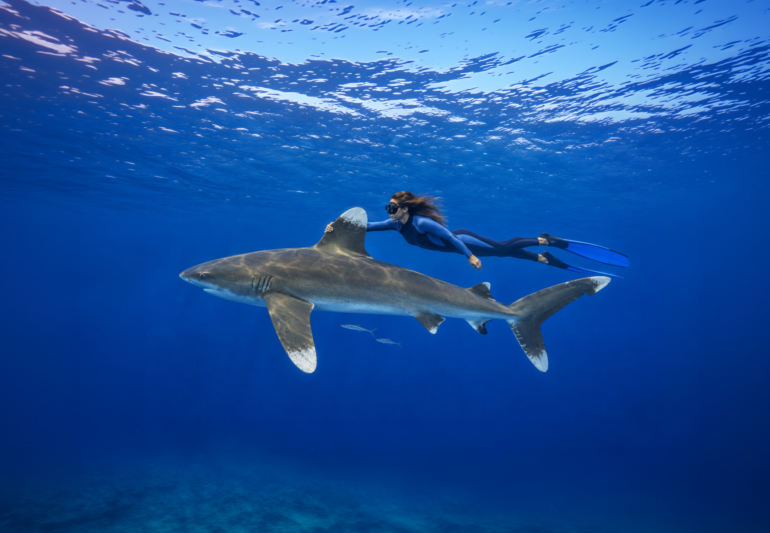
Social media influencers publish spectacular footage of themselves swimming extremely close to sharks, sometimes touching, redirecting or holding onto them. Such images can make unusual and potentially dangerous behaviour appear controlled and easily repeated.
Some of these snorkellers and freedivers have spent years learning to recognise changes in posture, speed, direction and approach behaviour. Viewers see their confidence and apparent ease, but rarely the accumulated knowledge, preparation or their supporting safety team. Nor do they see the occasions when an experienced specialist decides conditions are wrong and stays out of the water.
Even that experience cannot make an encounter with a large predatory shark completely safe. Behavioural signals can be misinterpreted, and a change in behaviour can have devastating consequences. An inexperienced swimmer trying to copy what they have watched may neither recognise the danger nor know when to withdraw. A bite that lasts only a moment can cause life-changing injury or death.
A warning not to copy the activity may do little to counter the images themselves. Repeated footage of sharks being touched or redirected without apparent consequence can persuade viewers that they, too, can do it. The concern is not simply what experienced individuals choose to risk, but what their example encourages others to attempt.
The International Shark Attack File classifies bites following attempts to feed, harass or touch sharks as provoked incidents. The overall risk of a shark bite remains very low. Low risk, however, is not the same as no responsibility. Conservation should encourage respect for sharks, not imply that wild predators can be treated as underwater companions. If a deliberately intensified encounter ends in a bite, responsibility should not automatically be transferred to the shark.
When disturbance becomes harm
In September 2026, images of a tourist couple sitting on a sea turtle at Ras Al Hadd Turtle Reserve in Oman sparked widespread global outrage on social media. The Environment Authority took legal action against them and reminded visitors that touching or disturbing wildlife is against the law.
There is no gentle way to describe the stupidity of sitting on a turtle for a photograph. Nor should camera flashes, crowding or close approaches be dismissed as harmless merely because they leave no visible mark.
A nesting female is at a vulnerable point in her reproductive cycle. Human presence and artificial light can deter or interrupt egg-laying. Lighting on nesting beaches can also disorient hatchlings trying to reach the water.
We cannot know from these images whether this turtle’s nesting attempt was disrupted. But disturbance at a nesting beach can affect reproductive success. A photograph is never worth that risk.
The cumulative weight of our presence
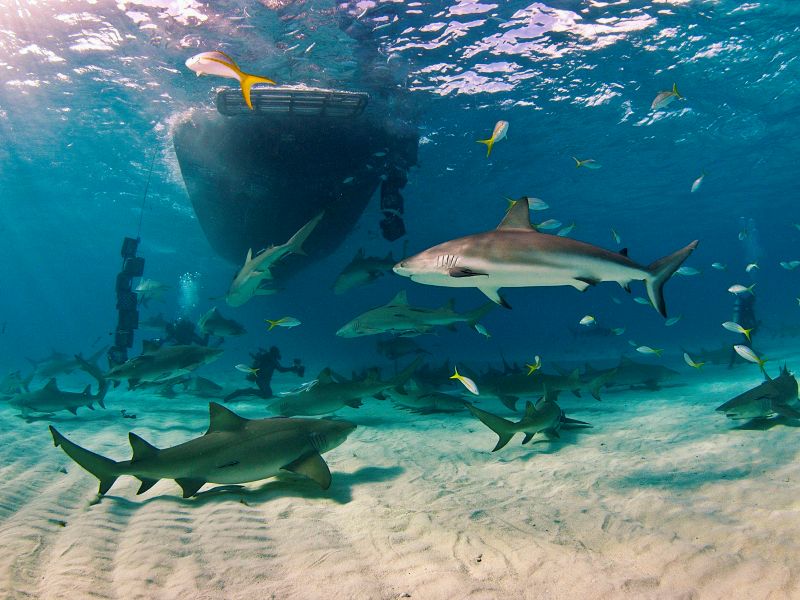
Touching is only the most visible expression of a larger problem. Growing marine tourism brings more boats and people into once quiet locations. Boats converge on sought-after animals. Engines add noise, propellers can kill and maim, while carelessly dropped anchors can damage living coral. Wildlife encounters become repeated interruptions as successive groups arrive.
Any single action may be dismissed as minor. The ecological threats lie in accumulation: one anchor multiplied by hundreds of trips; one disturbed turtle approached by successive groups; one coral head struck by the fins of visitor after visitor. These local pressures are being added to warming seas, coral bleaching, pollution, coastal development and overfishing. Marine tourism may not be the greatest threat facing the ocean, but that does not absolve it from reducing the impacts it can control.
The industry depends upon the health of the places and animals it promotes. If wildlife is repeatedly disturbed and reefs continue to deteriorate, the experience that attracts visitors will eventually diminish with them. Ethical practice is therefore not an obstacle to successful marine tourism; it is fundamental to its long-term survival.
We are guests
There are practical steps we can take, and responsibility needs to be shared. Divers and snorkellers should maintain distance and control their movement. Photographers should never manipulate wildlife for an image. Instructors should teach environmental awareness as an essential diving skill. Guides should intervene when customers behave irresponsibly. Operators should avoid crowding wildlife and refuse to market contact. Permanent moorings should be provided to prevent anchor damage.
Most importantly, we need to change the way we judge an encounter. Success should not be measured by how close we came, whether we touched the animal or whether we captured the image that will attract the most attention. It should be measured by how little we altered what was happening before we arrived.
My encounter with the Spanish dancer can’t be undone. I can only learn from it and allow that memory to inform the way I behave today. Greater experience should not make us bolder in our treatment of wildlife. It should make us more restrained.
We enter the ocean as visitors. Its inhabitants do not owe us contact, entertainment or photographs. The finest wildlife encounter is not the one in which we get closest. It is the one from which the animal swims away unchanged.
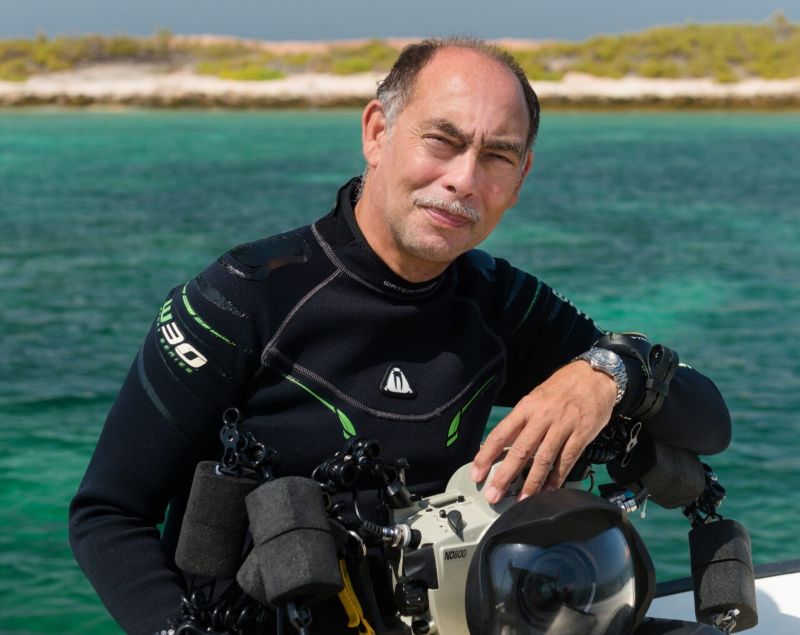
(Paul Flandinette is an author, environmental storyteller, and underwater photographer. Based in Oman since 2013, he is the photographer and co-author of Secret Seas, the first photographic book dedicated to Oman’s underwater world. Discover his books and photography at www.paulflandinette.com.)
Photography: www.paulflandinetteimages.com
© 2021 Apex Press and Publishing. All Rights Reserved. Powered by Mesdac