 By ANIRBAN RAY
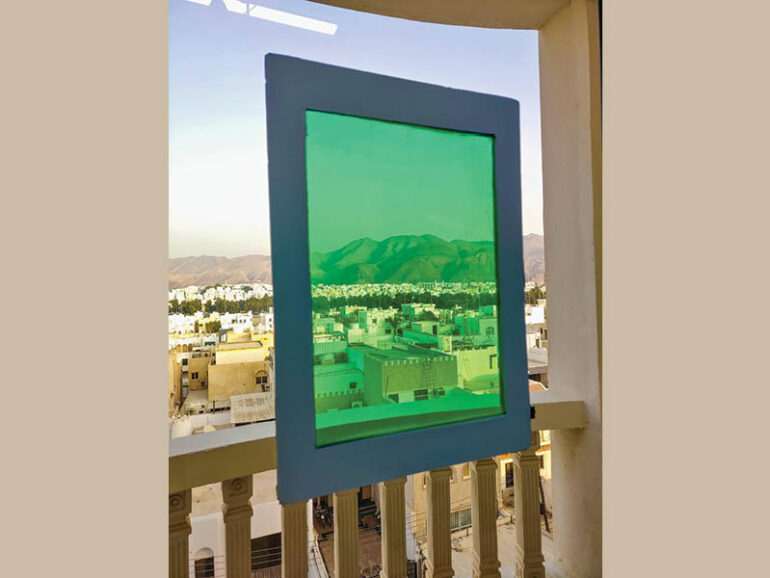
Muscat – A grade 10 student in Muscat is exploring the possibilities of transforming windows – the most ordinary feature of modern buildings – into a source of renewable energy without losing its primary function.
Gaurish Metha of Indian School Muscat is developing AETHER, a student-led engineering concept that aims to turn architectural glass into an electricity-generating surface. The project uses Carbon Quantum Dots (CQDs), derived from carbon-rich agricultural waste, and is designed to direct captured sunlight towards photovoltaic cells positioned around the edges of the glass.
“What makes AETHER different is that we are not simply trying to make another solar panel,” Gaurish said. “The core idea is to make the glass itself an energy-generating surface, while keeping the photovoltaic components largely outside the main viewing area.”
The concept emerged from research into transparent and semi-transparent solar technologies. Gaurish said the challenge is finding a practical balance between transparency, efficiency and cost, particularly when the technology is considered for large architectural surfaces.
AETHER aims to keep more than 92% of the main window area transparent, with the photovoltaic cells moved to the perimeter. The project currently targets more than 35% conversion efficiency for its specialised edge cells, although Gaurish stressed that these figures remain targets requiring experimental validation.
“A same-sized conventional solar panel would generate much more electricity because its entire surface is used for photovoltaic conversion,” he said. “But AETHER is solving a different problem – using the large glass surfaces of buildings and skyscrapers, where conventional rooftop solar cannot utilise most of that area.”

The CQD technology is central to the concept. Gaurish said the team initially explored organic luminescent pigments made from agricultural waste but moved towards CQDs after finding concerns over long-term UV degradation.
The proposed system would use CQDs to absorb sunlight, particularly ultraviolet radiation, and re-emit it as deep red light at around 690 nanometres. The light would then travel through the glass by total internal reflection towards photovoltaic cells along its edges.
However, Gaurish is clear that AETHER remains at the research and development stage.
“The CQD system has not been experimentally validated yet,” he said. “We have developed the technical architecture and research direction, but as students, we do not have access to the specialised facilities needed to fabricate and test the material ourselves.”
Oman presents both an opportunity and a challenge for the project. Gaurish points to the country’s strong sunlight and extensive use of glass in modern buildings, while acknowledging that heat, UV exposure, dust and humidity could test the technology’s durability. The team is targeting a potential lifespan of 20 to 25 years, subject to future testing under UV exposure, thermal cycling and humidity. “Our next major milestone is a physical proof of concept that demonstrates the complete optical-to-electrical chain,” Gaurish said.
The next stage will involve fabricating the CQD layer, testing its optical properties, verifying light transmission through the glass and measuring the resulting electrical output.
Gaurish is working with his friend and presentation partner Kaveesh Rayhan on the project.
© 2021 Apex Press and Publishing. All Rights Reserved. Powered by Mesdac