 By ANIRBAN RAY
Bonsai is ‘living art’. And if you intend indulging in it, you must first refine yourself, inculcate values, and pass it on with positive energy through your hands, a visiting bonsai master Kanta Hirota discloses. And now, this ancient Japanese art finds new roots in Oman
A little tree stands still with centuries of stories to unfold. Its twisted trunk speaks of storms weathered, its delicate branches of patient hands that have shaped them over generations… Every curve is intentional, every leaf a testament to discipline, artistry and time.
This is the enchanting world of bonsai – the centuries-old Japanese art of cultivating miniature trees that mirror nature’s grandeur while remaining alive and constantly evolving.
Unlike ordinary gardening, bonsai is not about stunting a tree. It is about creating harmony between nature and human imagination, good and bad, past and present, capturing the essence of a full-grown landscape within a single pot. Each tree becomes a living sculpture that changes with seasons, often requiring years of unwavering care.
This timeless philosophy recently captivated audiences in Oman when renowned Japanese ‘bonsai master’ Kanta Hirota, owner of the historic Toju-en Garden in Omiya Bonsai Village in Saitama Prefecture, visited the Sultanate as part of cultural exchange programmes organised by the Embassy of Japan.
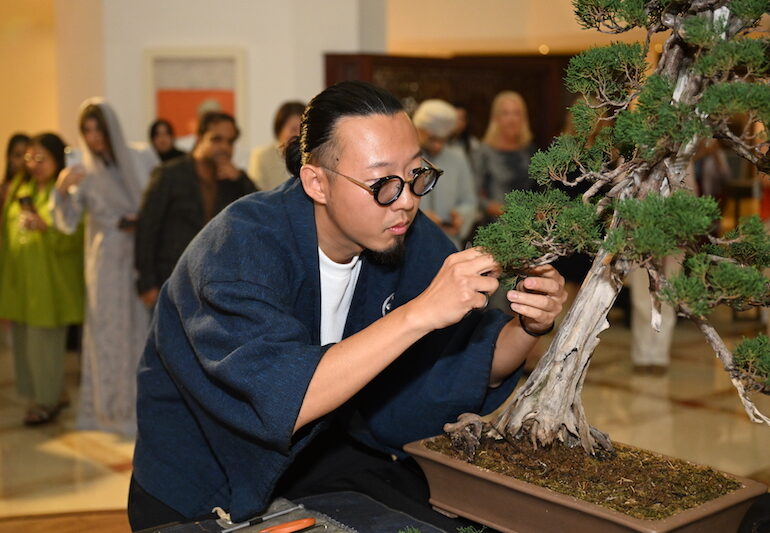
During his visit, Hirota conducted live pruning demonstrations and exhibitions at different locations including the National Museum of Oman while also hosting exclusive public bonsai cutting and styling performances in collaboration with the Embassy of Japan, Al Mouj, Takara Restaurant and Rocas Restaurant. His demonstrations offered visitors a rare opportunity to witness centuries-old Japanese traditions transformed into living works of art before their eyes.
A journey shaped by discipline
Hirota’s admits that his own path to becoming a bonsai master began unexpectedly. “My relative owned a bonsai nursery, and he later became my master. I had attended a high school that specialised in fashion, but I decided to leave and look for a different path in life. Around the same time, my master had been preparing to shut down his nursery. Somehow, he chose to take me in as his apprentice.”
Learning bonsai involved much more than mastering pruning techniques. They included being a good human being with a clear heart and conscience which is the base of every good work of art, he said.
“Before I learned bonsai techniques, I first learned how to become a proper person. I cleaned the garden, served tea, learned how to communicate with customers and observed every aspect of daily life around my master. It was not only bonsai training – it was training in character,” he said.
While many of his peers spent their youth enjoying leisure activities, Hirota immersed himself in study and practice. He used to spend his time studying instead of playing, building skills and experience day by day.
More than a tree
Watching Hirota shape a tree is like watching a sculptor carve marble – but with one important difference. Bonsai is living art. Each tree has been cared for with love over many generations. One single tree is not crafted by one single artist but by a set of different artists over generations giving every bonsai its own unique character. Unlike paintings or sculptures that remain unchanged once completed, bonsai continues to evolve.
Bonsai requires continuous care. During summer, it may need watering three or more times every day. The tree standing before us exists because someone never forgot to care for it – not even for a single day. Through careful pruning and delicate wiring, artists guide the tree without overpowering it, balancing artistic vision with respect for nature.
That is why bonsai is not simply gardening – it is living art. And for Hirota, every public demonstration is about much more than showcasing technique.
“I hope people who have never seen bonsai before discover this precious Japanese culture, which has been built over an extraordinary amount of time. I simply want people to feel something. Whether they think it is beautiful, cool, cute or amazing, any emotional connection is valuable.”
Discovering Oman’s hidden bonsai potential
One of the most fascinating aspects of Hirota’s visit was his exploration of Oman’s own natural landscape. During his demonstrations, he worked with a Japanese juniper while drawing attention to a remarkable discovery he made during an earlier visit to Jabal Akhdar.
“There are wild junipers growing there,” he said. “Some looked incredibly old – perhaps more than a thousand years old.” Seeing those ancient trees thriving in the harsh mountain environment convinced him that Oman possesses remarkable potential for bonsai cultivation.
“When I saw those trees surviving on a mountain with very limited water, I became convinced that bonsai has great potential in Oman.”
His ambition extends even further – to create bonsai using the frankincense tree, which is one of Oman’s greatest natural treasures. Such a project would blend one of Japan’s oldest artistic traditions with one of Oman’s most iconic native species, creating a unique cultural bridge between the two countries.
Although bonsai appears intricate, Hirota believes its basic requirements are surprisingly simple. The challenge, however, lies in adapting cultivation techniques to local conditions.
“Oman’s hot climate presents unique challenges, so proper cultivation methods need careful study.” Hirota plans to return regularly to continue researching how bonsai can flourish in the Middle East.
Life that never stands still
Some visitors compared bonsai to ‘ikebana’, Japan’s celebrated art of flower arrangement. Hirota explained that while both celebrate nature, their philosophies differ profoundly.
“In ikebana, the moment a flower is cut, its life begins to come to an end. The arrangement is considered complete at that moment.” But bonsai embraces an entirely different philosophy. Theongoing relationship with life, is what makes bonsai captivating, he explained.
As Hirota carefully shaped each branch before the Omani audience, he was doing more than pruning a tree. He was sharing a philosophy rooted in patience, respect and perseverance – values that transcend cultures. “We prune a tree so that it can live longer and become healthier. A bonsai is never truly finished. Every stage is complete for that moment, but it continues to grow and change over time,” he said.
© 2021 Apex Press and Publishing. All Rights Reserved. Powered by Mesdac