 By GULAM ALI KHAN
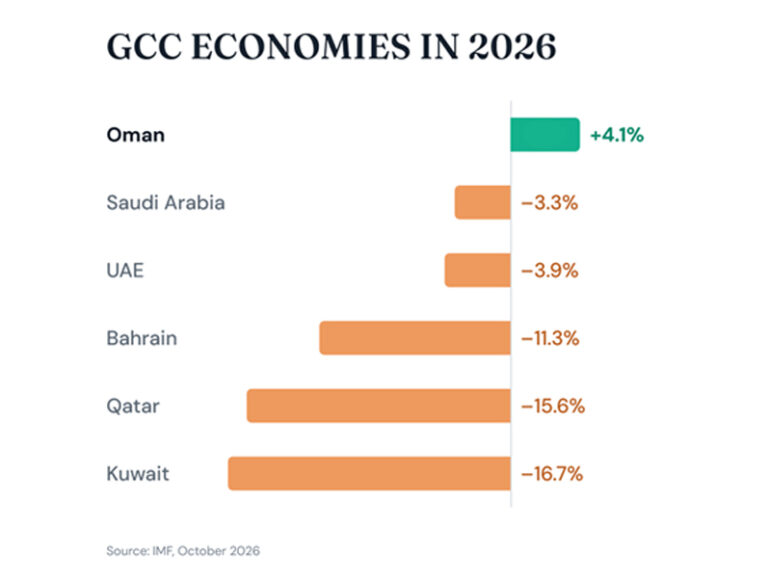
Muscat – Oman is forecast to be the only GCC economy to maintain positive growth in 2026, expanding by 4.1%, as the Middle East war and disruption to shipping through the Strait of Hormuz push its regional neighbours into economic contraction, according to the International Monetary Fund (IMF).
In its World Economic Outlook report, released on Tuesday, the IMF projects the economies of Saudi Arabia and the UAE to contract by 3.3% and 3.9%, respectively. The outlook is considerably bleaker for the other Gulf states, with Bahrain’s economy forecast to shrink by 11.3%, Qatar’s by 15.6% and Kuwait’s by 16.7%.
“Bahrain, Kuwait, and Qatar are projected to experience double-digit contractions of their economies in 2026, followed by double-digit expansions in 2027 as production, exports, and logistics normalise. Saudi Arabia is somewhat less affected, as an economy with more diversified export routes,” the IMF said.
Oman’s growth outlook stands in sharp contrast to the downturn projected across the rest of the Gulf region, highlighting how differences in exposure to the conflict and disruptions to energy supplies, export routes and logistics are shaping economic performance across the region.
The IMF’s forecasts point to a sharp divergence in the pace of recovery in 2027. While Oman’s economy is projected to grow by 2.2%, Saudi Arabia is expected to rebound by 7.9% and the UAE by 7.7%.
Bahrain, Kuwait and Qatar are forecast to expand by 13.9%, 17.1% and 18.8%, respectively, as production, exports and logistics normalise. The projected recovery in these three economies follows their steep contractions in 2026, reflecting the anticipated resumption of economic activity after severe disruptions caused by the conflict.
Beyond economic growth, the IMF expects Oman’s external position to strengthen. The sultanate’s current account balance is projected to swing from a deficit equivalent to 1.1% of GDP in 2025 to a surplus of 5% in 2026, widening further to 6.7% in 2027.
Consumer price inflation in Oman is forecast to rise to 3.2% in 2026 from 1% in 2025 before easing to 2.7% in 2027.
Hormuz disruption weighs on regional growth
The IMF’s regional economic forecasts reflect a longer-than-anticipated closure of the Strait of Hormuz and an expected stronger recovery as shipping through the strategic waterway resumes.
The conflict has delivered a major shock to energy supplies from the Gulf. Before the war, approximately 20mn barrels of oil passed through the Strait of Hormuz each day, accounting for around a quarter of global maritime oil trade, the IMF said.
The Strait remained largely closed to Gulf oil exports until the end of August, although shipping traffic increased significantly in September. Gulf crude exports averaged 16.7mn barrels per day in September, equivalent to 88% of pre-war levels, before falling to 13.4mn barrels per day by the end of the month, according to the IMF.
Much of the increase reflected the resumption of shipping through the Strait of Hormuz, replacing the use of alternative export routes through the Red Sea, according to the IMF.
© 2021 Apex Press and Publishing. All Rights Reserved. Powered by Mesdac