 By OUR CORRESPONDENT
Muscat – Oman has called for the development of alternative export routes for liquefied natural gas (LNG) to reduce reliance on the Strait of Hormuz, as continuing regional tensions disrupt energy shipments through the strategic waterway.
Energy security, supply diversification and infrastructure investment took centre stage at Gastech 2026 in Bangkok, Thailand where ministers from Egypt, Nigeria, Singapore, United States, Malaysia, Brunei and Türkiye, among others, discussed how governments are responding to rising demand and increasingly fragile supply chains.
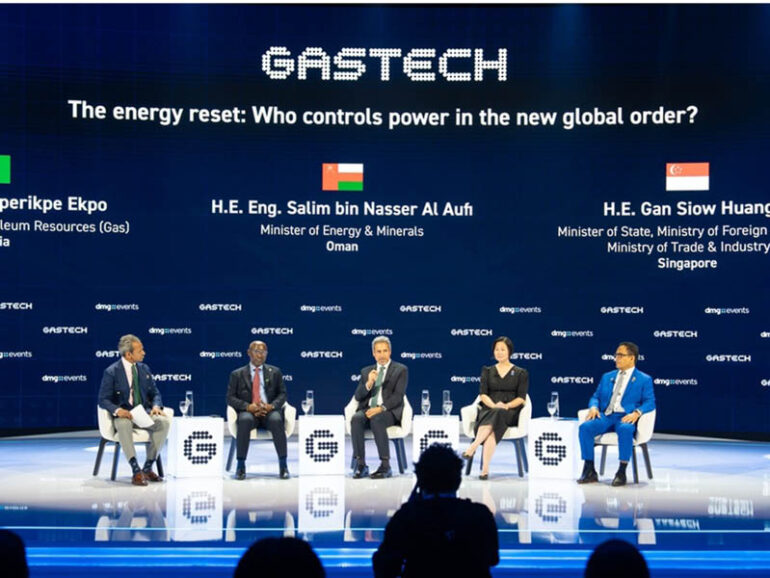
Speaking at the Gastech 2026 Strategic Conference on Monday, H E Salem bin Nasser Al Aufi, Minister of Energy and Minerals, said the fundamentals of oil and gas production remained unchanged, with resources, technology and production capabilities available.
He said the immediate challenge was moving energy from where it is produced to where it is needed, describing the current disruption as potentially short term while stressing the need to develop alternative export routes and diversify supply options.
“We need to identify alternative export options, whether through the north, through Oman or through Yemen. Diversify your options for getting resources out of the region,” H E Al Aufi said.
His remarks came as the global energy industry grapples with rising demand, accelerating electrification and growing energy security concerns.
The ministerial panel, titled ‘The Energy Reset: Who Controls Power in the New Global Order?’, examined challenges facing energy producers and consumers as geopolitical disruptions expose vulnerabilities in the movement of oil and gas, while electricity demand continues to rise across economies.
Being held from September 14 to 17, Gastech 2026 brings together ministers, chief executives, policymakers and investors to discuss partnerships, investment and strategic measures to strengthen energy resilience and secure supplies.
The conference and exhibition covers natural gas, LNG, low-carbon solutions, electrification and artificial intelligence.
H E Al Aufi’s comments also come as Abu Dhabi National Oil Company (ADNOC) Gas considers establishing a new LNG export facility outside the Strait of Hormuz, reflecting growing efforts among regional producers to strengthen export infrastructure.
Oman already has an LNG export facility at Qalhat near Sur on the country’s southeastern coast, which does not require shipments to pass through the Strait of Hormuz. Oman LNG operates three liquefaction trains at the site, with a combined capacity of 10.4mn tonnes per year.
The disruption to shipping has underscored the strategic importance of the Strait of Hormuz to regional energy exports and highlighted the vulnerability created by dependence on a single maritime corridor.
Against this backdrop, producers are exploring alternative arrangements to sustain energy flows and safeguard export capacity, while the wider industry assesses the implications of prolonged disruption for global energy security and supply chains.
© 2021 Apex Press and Publishing. All Rights Reserved. Powered by Mesdac