
Read on their own, two recent announcements from Oman might look like routine policy news. Read together, they say something much bigger about how this country intends to compete in the next decade.
The first is a policy move. The second is a capital commitment. Royal Decree No. 50/2026, issued on 30 April, formally established an Artificial Intelligence Special Zone in Muscat Governorate. In May, during Oman Sustainability Week, five companies signed on to build a 150MW sustainable AI data centre in the Sultanate. One sets direction. The other signals investment at scale. Together, they tell you Oman isn’t just chasing a headline about AI – it’s quietly building the operating conditions that make AI possible in the first place: land, energy, data infrastructure, regulation, capital, talent, and a market ready to actually use the technology.
The part everyone skips over
Everyone wants to talk about the software – the models, the code, the chatbots and this is the part most commentary on ‘AI strategies’ gets wrong. Almost no one wants to talk about the unglamorous physical and regulatory scaffolding underneath it. But AI doesn’t run on ambition. It runs on compute, power, connectivity, and rules for how data can move. Oman, to its credit, seems to understand that the less glamorous infrastructure question is the real strategic question.
What’s actually being built
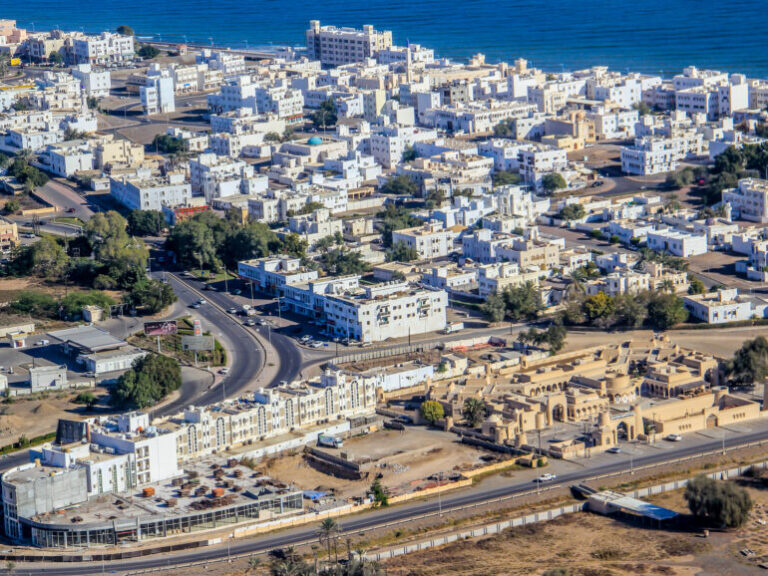
The zone itself is being planned in the Wilayat of Seeb, on roughly 104,000 square metres next to the Civil Aviation Authority building. The data centre agreement brings together an unusually international mix of partners – RINA Consulting, Vitali Spa, and Forte Secur Group from Italy, Ahlam Group from Oman, and Corpolgia from Dubai – with a deliberate focus on energy efficiency and sustainability. That detail matters more than it might seem. AI infrastructure is power-hungry by nature, and a country the size of Oman can’t afford to build data centres that strain its energy grid rather than strengthen it.
Where this fits in the bigger picture
Zoom out, and this fits neatly into Oman’s Vision 2040 story – diversification, private-sector growth, innovation, and sustainable development, with the National Digital Economy Program aiming to lift the digital economy’s share of GDP from around 2% to 10% by 2040. In that light, an AI zone isn’t a vanity project. It’s a lever for competitiveness and productivity, and – if done right – a genuinely new economic sector rather than a repackaged old one.
None of this is unfamiliar territory for Oman, either. The country has long used special economic zones, free zones, and industrial cities to bundle capital, infrastructure, and sector focus into one place. What’s happening here is the same playbook, just pointed at the digital economy instead of logistics or manufacturing: build the right conditions first, then let sectors and companies build on top.
Forget Silicon Valley – this is the real opportunity
The real opportunity is in applying AI directly to the economic systems Oman already depends on. Ports and customs can get sharper with better cargo tracking and risk analysis. Industrial zones can run more efficiently with AI-driven equipment monitoring. Energy and water utilities can use predictive maintenance and demand forecasting. Government services can move faster when routine, repetitive processes are automated responsibly. You can already see a version of this logic in homegrown companies like Saheeb, an Oman-based technology firm building AI-enabled products for practical, local problems – not as a flashy pitch-deck idea, but as proof that AI creates more value when it’s tied to a specific problem than when it floats as an abstract buzzword. A zone can hand you land, power, permits, and fibre – and still not give the desired output if the data underneath remains fragmented, if talent is flown in without transferring any real knowledge to Omanis, or if companies can’t actually plug AI into their day-to-day workflows. In that scenario, a country ends up hosting AI activity without capturing much of its value.
What success should look like
That’s why the private sector will ultimately decide whether this works. Government can build the frame. Companies, institutions, and investors have to fill it with actual economic activity. Oman’s AI Zone would be judged not by how many companies register or how much space gets leased, but by simpler, harder-to-fake signals: local firms genuinely adopting AI, Omani talent being trained rather than sidelined, sector-specific products getting built and sold, and, ideally, solutions born in Oman that eventually find customers well beyond it. Oman isn’t starting from zero here. It already has the industrial zones, ports, energy assets, and planning muscle that most countries building an ‘AI strategy’ from scratch would envy. If it can connect that base to real data readiness, real local skills, and real private-sector demand, the AI Zone won’t just be a place where AI companies set up shop. It’ll be part of the infrastructure that makes AI actually useful for whatever comes next in Oman’s economy.
Matvii Diadkov is a technology entrepreneur, venture builder, and investor focused on AI and digital infrastructure, building and scaling technology companies across Europe and the Gulf. He is co-founder of Saheeb, an Oman-based technology company referenced in this piece. He welcomes relevant professional connections on LinkedIn.
© 2021 Apex Press and Publishing. All Rights Reserved. Powered by Mesdac