 By OUR CORRESPONDENT
Jaalan Bani Bu Hassan – The annual tabseel season has begun across the villages of the wilayat of Jaalan Bani Bu Hassan in South Sharqiyah, reviving one of Oman’s oldest agricultural traditions and highlighting the enduring cultural and economic importance of the date palm.
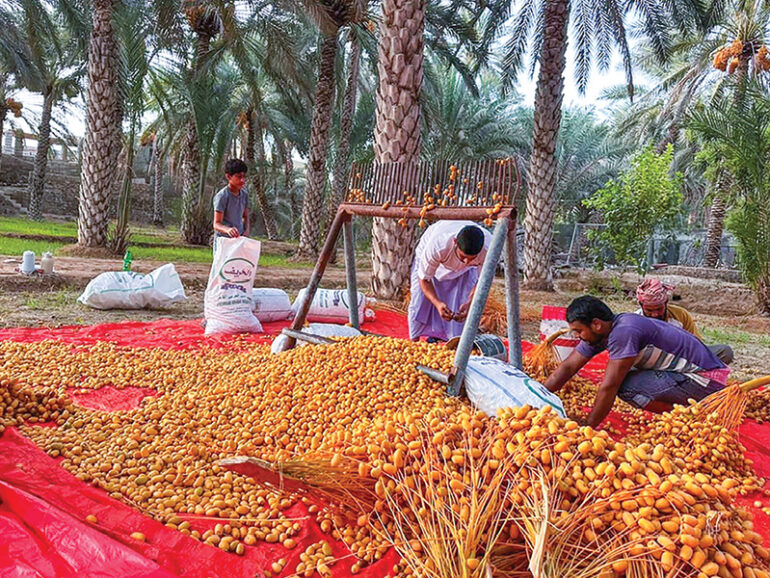
Coinciding with the start of summer, farmers and families have commenced harvesting unripe dates and preparing them for the traditional tabseel process, a centuries-old practice through which dates are processed and preserved for long-term use. The season remains a key feature of rural life in the governorate, bringing together communities in a collective effort that reflects the deep-rooted relationship between Omanis and the date palm.
Tabseel begins with the harvesting of unripe dates, particularly from the Mabseli variety, which is widely cultivated in Jaalan Bani Bu Hassan. The dates are carefully sorted and cleaned before being transported to designated processing sites known locally as ‘Turkba’. There, they are cooked in large cauldrons using traditional methods inherited through generations.
Following the cooking stage, the dates are drained and spread across specially prepared surfaces under direct sunlight. Over several days, they gradually dry and harden, developing their distinctive colour and texture. The final product, known locally as ‘Faghour’, is valued for its durability, nutritional benefits and long shelf life, making it suitable for storage, household consumption and commercial sale.
Beyond its agricultural significance, the tabseel season serves as a social and cultural event that strengthens community bonds. Families participate in every stage of the process, from harvesting and transportation to drying and storage. The cooperative nature of the work reflects longstanding traditions of mutual support and collective labour that have characterised Omani agricultural communities for generations.
The season also plays an important economic role. According to estimates by the Ministry of Agriculture, Fisheries and Water Resources, South Sharqiyah governorate produced around 28,951 tonnes of dates in 2025. Jaalan Bani Bu Hassan alone contributed 12,933 tonnes, representing 44.67 % of the governorate’s total production.
The wilayat has approximately 199,427 productive date palms, with an average yield of 65kg per tree. The mabseli variety remains the dominant cultivar, accounting for an estimated 8,072 tonnes of production from 119,408 palms, or more than 62% of the wilayat’s total date output.
© 2021 Apex Press and Publishing. All Rights Reserved. Powered by Mesdac