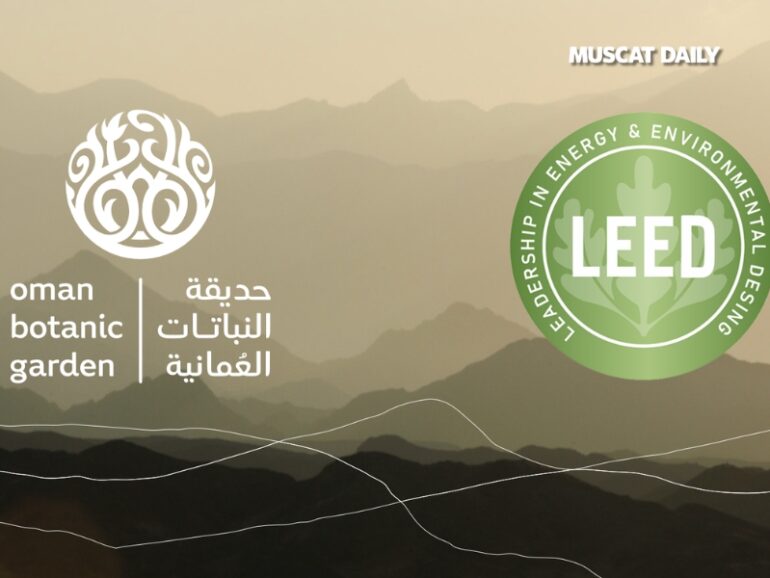
Muscat – Oman Botanic Garden (OBG) has achieved LEED Platinum certification across four of its key facilities, marking a major sustainability milestone and reinforcing its position as a national, regional and global model for environmentally responsible design, construction and operation.
Awarded under the LEED v2009 New Construction rating system by the U.S. Green Building Council, the Platinum certifications recognise OBG’s exceptional performance in energy efficiency, environmental stewardship and sustainable building practices. LEED Platinum represents the highest level of certification within the globally recognised green building framework.
A Comprehensive Sustainability Achievement
The LEED Platinum certifications apply to four major components of Oman Botanic Garden: the Hajar Mountains Biome, Dhofar Mountains Biome, Deserts Pavilion and Visitor Centre. Among OBG’s most complex structures, the Dhofar Mountains Biome achieved 86 LEED points, representing the highest score recorded among LEED-certified buildings in the Sultanate of Oman. Together, these certifications reflect an integrated sustainability strategy implemented across OBG’s most prominent built assets, embedding green design principles into architecture, energy systems, material selection, water management and long-term operational performance.
OBG has also achieved an Urban Compliance Certification for the Dhofar Mountains Biome under the Ministry of Housing and Urban Planning’s initiative to assess alignment with the Omani Building Code (OBC), recognising best practice in engineering and architectural compliance and operational efficiency.
Leadership in Sustainable Design and Environmental Stewardship
This achievement underscores OBG’s commitment to environmental excellence and alignment with international best practices in sustainable development. From the earliest design stages, sustainability has been embedded as a core principle of OBG, ensuring reduced environmental impact while enhancing visitor experience, operational efficiency and long-term resilience.
Across the certified buildings, sustainability is expressed through high-performance energy systems, the integration of renewable energy solutions, responsible material selection, advanced water efficiency measures and environmentally conscious architectural design. Collectively, these measures support Oman’s broader sustainability ambitions and contribute directly to national objectives under Oman Vision 2040.
A National, Regional and International Benchmark
With multiple LEED Platinum certifications, OBG stands among a select group of large-scale cultural and environmental projects worldwide to achieve this level of sustainability recognition within a single destination. The achievement strengthens OBG’s role as a flagship sustainability project for the Sultanate and positions it alongside leading regional and international developments that meet the rigorous standards of the U.S. Green Building Council. It further reinforces OBG’s value not only as a destination for conservation, learning and tourism, but as a living demonstration of how environmental responsibility and world-class development can successfully coexist at scale.
Commitment Beyond Certification
Beyond meeting certification requirements, OBG has been designed as a long-term environmental asset supported by robust, sustainable infrastructure.
OBG operates a large-scale on-site solar power system comprising more than 11,000 solar panels installed across an area of 52,000 square metres, generating approximately 6,493 megawatt hours of electricity annually. This system reduces carbon emissions by nearly 4,700 tonnes per year, supplies clean energy equivalent to the needs of around 500 homes and delivers annual electricity cost savings exceeding OMR 250,000, reinforcing OBG’s commitment to renewable energy and operational efficiency.
Water sustainability is addressed through an advanced Treated Sewage Effluent (TSE) plant, which recycles approximately 618 cubic metres of treated water daily for irrigation and operational use, significantly reducing dependence on potable water resources. Water consumption varies by season, with peak demand reaching approximately 400–500 cubic metres during the summer months, during which recycled water remains the primary source for irrigating plants across the garden.
The LEED Platinum certifications serve as an independent global validation of the OBG’s vision, execution and commitment to environmental stewardship, positioning Oman Botanic Garden as a reference point for future sustainable developments in the region and beyond.
© 2021 Apex Press and Publishing. All Rights Reserved. Powered by Mesdac