 By GULAM ALI KHAN
Muscat – Oman is projected to be the fastest-growing economy in the GCC in 2026, supported by limited exposure to regional disruptions and gains from higher oil prices, according to the International Monetary Fund (IMF).
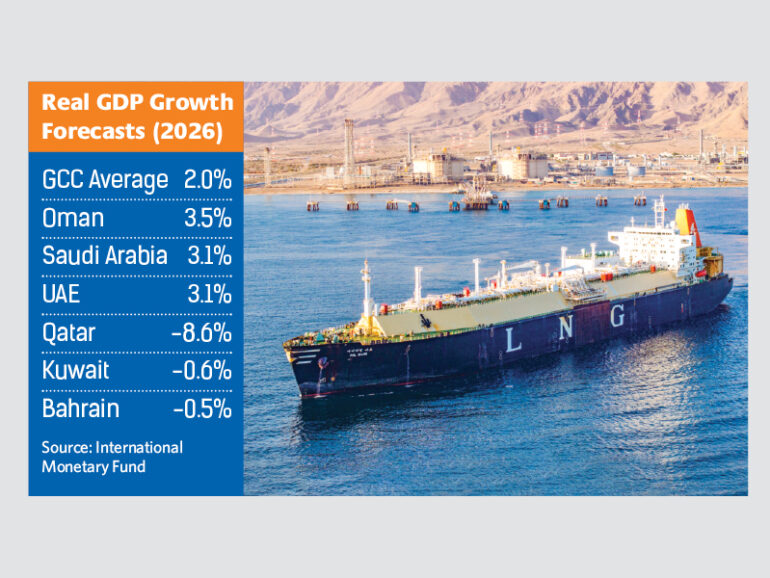
In its 2026 Regional Economic Outlook for the Middle East and Central Asia, the IMF said Oman is expected to record real GDP growth of 3.5% in 2026 – the highest among GCC countries – even as the region grapples with the economic fallout from the ongoing Middle East conflict.
The fund noted that the US-Israel war with Iran, which led to the closure of the Strait of Hormuz and widespread disruptions to energy production, has resulted in sharp downward revisions to growth across the Gulf economies. However, Oman has been the least affected, with only a modest downgrade of about 0.5 percentage points in GDP growth.
In comparison, growth projections for other regional economies are significantly weaker, with several countries – including Kuwait, Qatar and Bahrain – expected to contract in 2026, reflecting greater exposure to disruptions in energy production and trade routes.
At the centre of the shock is the Strait of Hormuz, the world’s most critical energy chokepoint, through which around one-fifth of global oil supply and roughly one-quarter of LNG trade normally pass. The conflict has brought traffic close to a standstill, while strikes and precautionary shutdowns have reduced oil and gas output across the GCC by an estimated 13mn bpd of oil and the equivalent of about 3.5mn bpd of natural gas, the IMF said.
However, Oman’s geographical position outside the Strait of Hormuz has helped it avoid the severe logistical and export disruptions faced by other Gulf producers.
“In the case of Oman, trade and production disruptions have been minimal because its sea access lies completely outside the Strait of Hormuz,” said Jihad Azour, Director of the Middle East and Central Asia Department at the IMF.
“For Oman, the increase in oil prices is expected to boost both the current account and primary fiscal balance by several percentage points compared to pre-war levels,” Azour added.
In contrast, three Gulf countries are likely to see a deterioration in fiscal and external balances, as energy production and export disruptions outweigh the benefits of higher oil prices.
Despite Oman’s relatively strong outlook, the IMF cautioned that risks remain elevated, particularly if the conflict persists or intensifies. Prolonged disruption could lead to further volatility in oil prices, tighter global financial conditions, and broader spillovers through trade and investment channels.
The fund noted that the ceasefire agreement announced on April 7 marks an important step towards de-escalation. ‘However, uncertainty remains high and much will depend on whether the ceasefire holds and regional stability is restored.’
Over the longer term, the IMF emphasised the need for GCC countries to diversify trade routes, strengthen critical infrastructure, and deepen regional cooperation in essential goods and energy to build resilience.
© 2021 Apex Press and Publishing. All Rights Reserved. Powered by Mesdac