 By
By
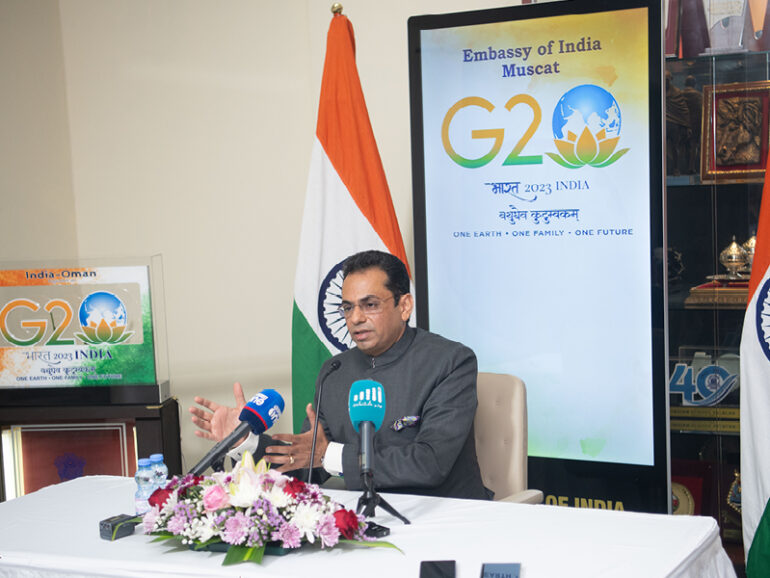
Muscat – The Indian Ambassador to Oman was all praises for the sultanate when he met the press on Monday in Muscat to share India’s experience while conducting the G20 Summit under its presidentship.
H E Amit Narang said that the sultanate – as a special guest country in the summit – hugely contributed to the summit discussions, which spanned over several sectors including sustainable living, social security, fight against corruption and others.
Nine Omani ministers, besides a battery of officials from the sultanate participated in the G20 process at the special invitation of the Republic of India.
Oman has contributed greatly by giving its perspective at the global platform.
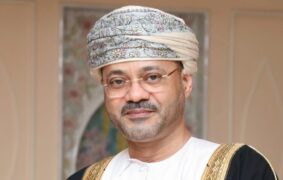
“To give you a sense of how tangible this effort was, I am happy to mention that Foreign Minister H E Sayyid Badr al Busaidi in his remarks at the Voice of Global South Summit had laid out ‘social justice’ and ensuring a ‘just transition’ as key priorities for Oman.
“Both of these priorities were well captured in the New Delhi Declaration,” the Indian ambassador noted.
H E Narang said that the global leaders are concerned about the rising inequalities within a country and among different countries and the paragraph 4 of the New Delhi Declaration specifically addresses this.
‘Together we have an opportunity to build a better future. Just energy transitions can improve jobs and livelihoods, and strengthen economic resilience. We affirm that no country should have to choose between fighting poverty and fighting for our planet. We will pursue development models that implement sustainable, inclusive and just transitions globally, while leaving no one behind’, reads para 4 of the G20 New Delhi Leaders’ Declaration.
The Indian ambassador made a special reference to the India-Middle East-Europe economic corridor involving India, Saudi Arabia, the United Arab Emirates, Jordan, Israel and the European Union.
The first-of-its-kind economic corridor – a historic initiative on connectivity and infrastructure – would help boost trade, deliver energy resources and improve digital connectivity.
Asked about Oman’s significance in this particular project given the fact that the sultanate is part of an ambitious regional rail network, the Indian ambassador chose to allow things to unfold as the project goes into its implementation phase.
“What I can say is that it’s an initiative with a lot of promise. It can be the blueprint for the collective rejuvenation of the economy of the entire region. As the project moves into the implementation phase, we’ll get to know more details.”
As far as the sultanate and India is concerned, the Indian ambassador said, “We’re already very close economic powers and our partnership spans over several sectors, including energy, information technology etc.”
He asserted that both the countries are united in their drive in infrastructure creation. “India is on a record breaking speed for infrastructure creation within the country. In Oman as well, they have ambitious plans including for railways. These are plans in which India can be a valuable partner.”
While talking about economic partnership between the two countries against the backdrop of G20’s assertion on greater connectivity and trade relations, the Indian ambassador expressed pride in informing the media that the bilateral trade between the two countries more than doubled during the past two years.
“It has gone from US$5.6bn to US$12.4bn in the last financial year,” he said, to buttress his comment that the economic engagement between India and Oman is on an upward swing.
H E Narang believes this growth is just the tip of the iceberg. “Both countries are working together to further upscale their economic engagements and explore the full potential of their partnership.”
© 2021 Apex Press and Publishing. All Rights Reserved. Powered by Mesdac