 By MOHAMMED TAHA
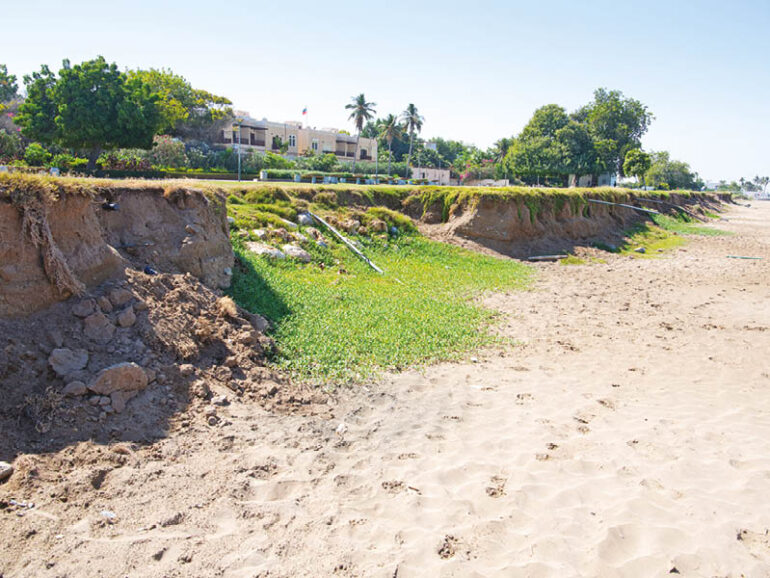
Muscat – The coastline in some wilayats in North Batinah and South Batinah is receding by up to 90cm yearly, according to the latest survey of the Environment Authority (EA).
Rising sea levels create stress not only on the physical coastline, but also on coastal ecosystems. Saltwater intrusions lead to contamination of freshwater aquifers, many of which sustain municipal and agricultural water supplies and natural ecosystems.
Speaking to Muscat Daily, Mohammed Juma al Ruzaiqi, head of EA’s Coastal Zone Management Department, said the survey’s results show an irregular rise in sea level in the wilayats of Barka and Musannah in South Batinah and Sohar and Shinas in North Batinah.
“There is erosion along the coastline in the Batinah region in general. The results show coastal erosion by 85cm to 90cm per year in Barka, Musannah and Sohar, while in Shinas, the coastline has eroded 37cm this year.”
A study conducted by Sultan Qaboos University in 2014 titled ‘Coastal Erosion in Al Batinah’ found the sea level rise (SLR) problem to be severe in the Batinah coast, retreating at a rate of about 60cm/year.
Another 2014 SQU study – ‘GIS-based Framework for the Simulation of the Impacts of Sea Level Rise and Coastal Flooding on Oman’ – found that Oman is highly vulnerable to climate change-induced SLR.
‘At the national scale, nearly 400km2 of total land area is projected to be inundated under the smallest SLR scenario, while under the highest SLR scenario, over 900km2 will be potentially inundated. An assessment of the vulnerability of productive land use showed that the Batinah and Muscat governorates are the most vulnerable under all SLR scenarios,’ the study stated.
Ruzaiqi informed that in 2021, EA launched a programme to combat coastal erosion in the governorates of North Batinah and South Batinah, and held workshops to develop plans to reduce the phenomenon.
The authority has also cooperated with experts from the private sector as well as Sohar University to use drones to survey and photograph relatively damaged sites. “Experts analysed these images and compared them with satellite images from the past to monitor the increasing erosion of the beaches in the sites being studied,” Ruzaiqi said.
He informed that the authority will continue the monitoring project with drones this year at the same sites in addition to others to obtain accurate new data.
EA also will coordinate with concerned authorities to develop the necessary solutions, including wave breakers and dumping sand on the beaches witnessing rapid erosion.
© 2021 Apex Press and Publishing. All Rights Reserved. Powered by Mesdac