 By ANIRBAN RAY
Mirbat – an old town, once known for the finest Arabian horses, now stands replete with memories of a vibrant past, dilapidated heritage structures, and ancient dhows, all of which are still a big draw for tourists
If you want to feel close to nature as well as revel in scenes reminiscent of Oman’s history and traditions, Mirbat is the place to visit.
Once known for its exotic Arabian horses – the prized and gorgeous equine beasts had held sway here for centuries – Mirbat now continues to provide the visitor a feel of old times in Oman. Though trade in horses doesn’t continue here anymore, Mirbat still carries this stamp of days bygone.
As one enters the city, located around 75km east of Salalah, one notices that the entrance is marked with stone installations of two brown stallions on either side of the road. The steeds remind the guest of the long lost memories of their domination in the green and ochre plains until a few centuries back.
An old coastal fishing town, Mirbat is among the prominent ten wilayats of Dhofar Governorate. The calm town is situated between Jebel Samhan and the Arabian Sea. Golden beaches adorn the city with occasion drizzles and breeze carrying the strong odour of fish.
The coastline is decked with an array of dhows (traditional boats) and the sight resembles a chapter from ‘Arabian Nights’. The pristine coastline of the town is a cacophony of sounds from seagulls, busy fishermen, shutterbugs and grazing cattle.
Salim Amri, a boatman, said, “Fishing in Mirbat is a very special experience. As ones goes deep in the sea, one can feel a touch of history that has been as old as human existence itself. There is no geographical proof that I can provide but the feeling that arises in the middle of the sea is mesmerising. There is no pollution and sometimes dolphins, like old friends, pop up to greet us.”

The city has many old mosques and houses. Most people have left this town for a livelihood in Salalah or Muscat. The joint family tradition has been gradually weakening – as one travels the narrow lanes of the town one can see old ‘baits’ (homes) wherein once huge families resided.
Most houses have an open courtyard and an array of rooms. Separate areas were also allocated for animals, like horses and camels, which later made way to park cars. Most of the dilapidated houses are protected by the local municipality for heritage value but some can be seen crumbling to form just a heap of stones and rubble.
Adnam, a tour guide, disclosed, “These houses have been as old as over 200 years, and when they are pulled down, the folk staying around come and bid farewell. The people here, especially the very senior citizens, feel very emotional. They are also wise and tolerant, but are resigned to the fact that the old must make way for the new.”
Before the development of hotels in Salalah, the old houses in Mirbat were very much in demand from bagpacking tourists who prefered to rough it out and stay in the old houses for a nostalgic feel of life here. However, now, many of these old dwellings have been demolished to make way for new constructions.
You also encounter herds of sheep, cows and camels strolling around the lanes in Mirbat and the stench of dung has its own way of taking one back in time, in contrast to modernisation where the smell of fuel seems to indicate development.
Very close to the entrance of the town lies a whitewashed tomb of Mohammed bin Ali – a respected religious leader who died in 556H (1161 AD). There is a big graveyard around the tomb and tourists often come to pay tributes.
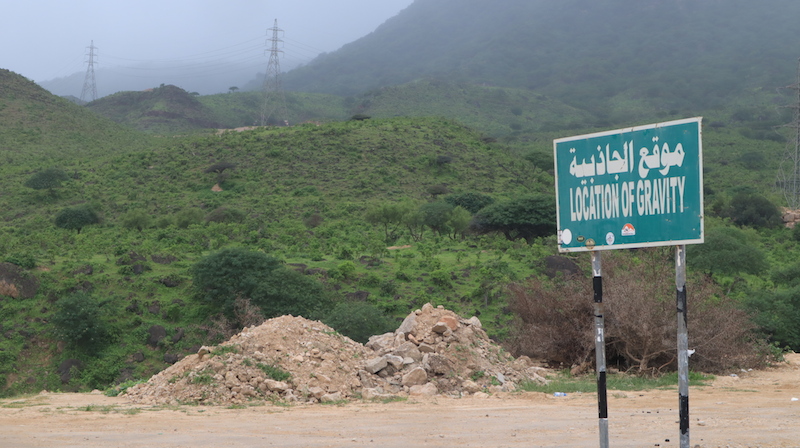
One of the most interesting places for a tourist close to Mirbat is the anti-gravity point. It is a magical place where one can witness a car in neutral gear moving uphill on a gradually inclined road. Known by many names – Magnetic Hill, Gravity Hill, Magnetic Point, Gravity Point and Location of Gravity – this stretch is located near Tawi Atair and Mirbat and one can visit it on the way to Mirbat.
© 2021 Apex Press and Publishing. All Rights Reserved. Powered by Mesdac