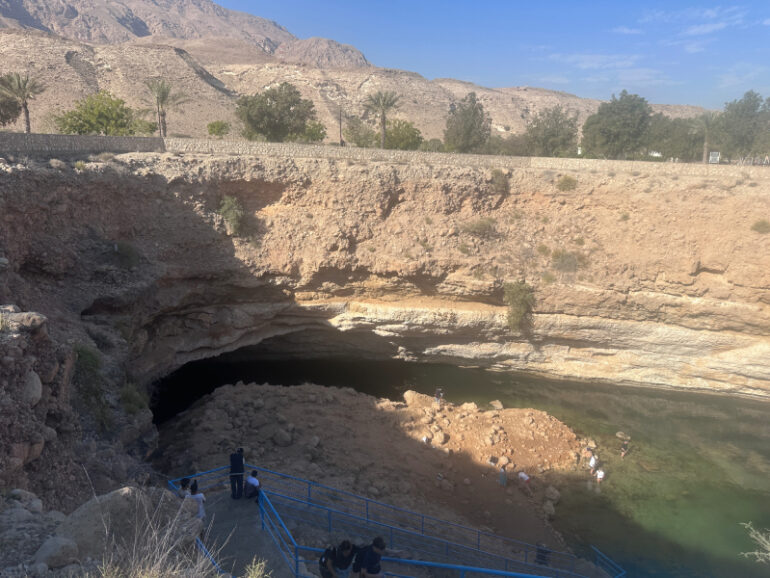
Behind the rocky plains and quiet desert sands of Quriyat, Muscat, just 600m from Oman’s coastline, lies Hawiyat Najm, widely known as the Bimmah Sinkhole. Formed centuries ago through the collapse of limestone rock, this 20m-deep sunken courtyard filled with turquoise water has become one of Oman’s most treasured natural wonders. Drawn by the striking colour of its waters, visitors from the city and beyond have long paused here to admire its beauty and share meaningful moments with family and friends.
Wanting to experience the site for myself rather than through images shared online, a day trip to Hawiyat Najm Park became an opportunity to understand what natural heritage truly represents. The sculptural forms and warm tones of the limestone cliffs, contrasted against the blue-green water below, created a remarkable view. The scene was so inviting that it was almost impossible not to feel tempted to swim, or at the very least, dip one’s feet into the water.
However, the concrete staircase of more than fifty steps leading down to the sinkhole presented a significant challenge. Elderly visitors and people with disabilities were left to admire the site from afar, a quiet reminder that access to natural beauty has not always been equal, as age and disability lie beyond one’s control. With scattered trees and only a few shaded pergolas, many families were exposed to harsh sunlight throughout the day. Washrooms are available only at the main entrance, and the absence of retail outlets for necessities, further highlighting the park’s shortcomings.
Children were able to use the playground only after sunset, while young adults gathered to play frisbee and board games in the cooler evening air. Some visitors, including myself, enjoyed walking beneath the open sky as the sun set beautifully, hoping to extend our stay into the night. Unfortunately, the lack of a proper camping environment ultimately marked the end of our adventure. Clearly, the park’s full potential has yet to be realised, despite the strength and presence of its natural features.
Could gentle interventions transform the park into a hub where nature is embraced, culture respected, livelihoods supported, leisure encouraged, and dignity upheld, making it a true heritage landmark?
A possible beginning lies in the creation of differentiated zones within Hawiyat Najm Park, linked by thoughtfully designed pathways that engage visitors of all ages through a range of activities. For those wishing to explore the sinkhole more closely, a panoramic viewing bridge combined with an elevator could offer optimal views and allow people with disabilities to experience the site more directly. Context-sensitive retail kiosks and food carts, modest in scale and material, could enhance the visitor experience while supporting informal local businesses.
Cycling paths could introduce an active and sustainable mode of movement across the park, encouraging longer stays and broader exploration. With the surrounding Rocky Mountains framing the landscape, a carefully positioned zip line could add a controlled sense of adventure, increasing visitor interest through its rarity. A well-designed children’s zone would ensure both enjoyment and safety, allowing parents to feel at ease. For visitors seeking deeper engagement with nature, camping and glamping facilities, ranging from modest tents to luxury caravans overlooking the terrain and coastline, could further strengthen the park’s identity. In this way, Hawiyat Najm would be recognised not as an absence to be filled, but as a formidable presence that warrants respectful framing.
In recent months, Hawiyat Najm has come under review by Muscat Municipality, with discussions indicating that some of these potential interventions may become a reality in 2028. The Municipality’s care-oriented vision reflects a quiet attentiveness to Oman’s raw natural beauty and a shared preference for thoughtful care over dramatic change. Its initiative to engage with the site through measured and sustainable observation demonstrates an understanding of its environmental and cultural sensitivity. By gently addressing visitor accessibility, comfort, and landscape enrichment while remaining in harmony with nature and heritage, Hawiyat Najm shall remain a place not merely visited, but deeply felt.
Preserved as a shared natural legacy shaped by care and memory, its long-anticipated unveiling promises a renewed encounter with wonder, guiding visitors through a dialogue between nature and architecture. An awakening of place that stirs the imagination and proudly lives up to its name: The Fallen Star.
About the Author
Fatma Humaid Khalfan al Mahrooqi is an Omani practising architect at Huckle Design. With a keen interest in raising awareness of architectural discourse, she is passionate about exploring and contributing to the field. Through her writing, she aims to share insights, foster understanding, and inspire others within the industry. Her work reflects a strong commitment to innovation and advancing architectural knowledge.
© 2021 Apex Press and Publishing. All Rights Reserved. Powered by Mesdac