 By
By
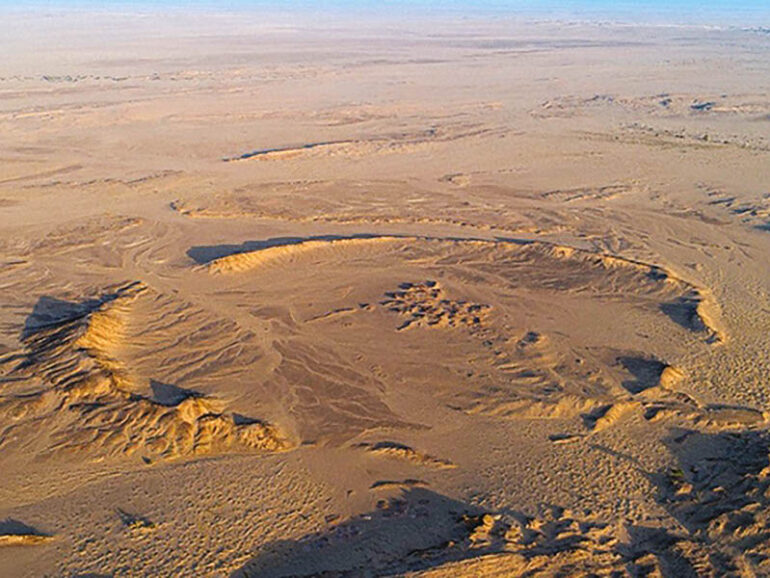
Muscat – Sultan Qaboos University, represented by the Department of Earth Sciences at the Faculty of Science, announced the discovery of a huge meteor crater – one of the largest shock craters in the Middle East – with a diameter of one kilometre in Mahout in Al Wusta governorate.
Prof Sobhi Jaber Nasr from the Department of Earth Sciences in SQU said, “The crater is 60mn years old. The diameter of the meteorite which caused this crater could have been between 50 and 60 metres to make it one of the largest impact craters in the Middle East.”
This discovery offers a rare site for scientific studies to evaluate the overall impact of a meteor of this size on the entire area. It also grants Oman a special place in the study of meteoric impact due its distinction and geological heritage, where the ophiolite rocks are said to be the first and unique ones to surface.
These rocks absorb an estimated 100,000 tonnes of carbon dioxide annually, which help combat global warming naturally. Rock fragments at the site of the discovered crater show signs of melting and recrystallisation during the collision, during which sandstones quickly heats up to over 1200°C.
Analyses of unmelted rock masses show the presence of minerals such as calcite and quartz crystals with a distinctive pattern of parallel and flat cracks, indicating result of shock waves travelling through the bedrock.
Studies also brought to light the magnitude of the collision with the asteroid that hit the region.
On the other hand, the results showed glass fragments of teardrop shapes, and pieces of glass perforated with small holes resulting from gas bubbles.
These two features indicate the occurrence of a high-intensity collision, while geophysical surveys indicate distinctive vascular layered shape of the impact craters.
The site is expected to contain some economic minerals and will be an important site for domestic tourism, international science, and national heritage.
© 2021 Apex Press and Publishing. All Rights Reserved. Powered by Mesdac