 By OUR CORRESPONDENT
Muscat – Calls for tighter controls on heavy trucks and stricter enforcement of road safety regulations have intensified following the Samail crash that killed six people and injured 18 others.
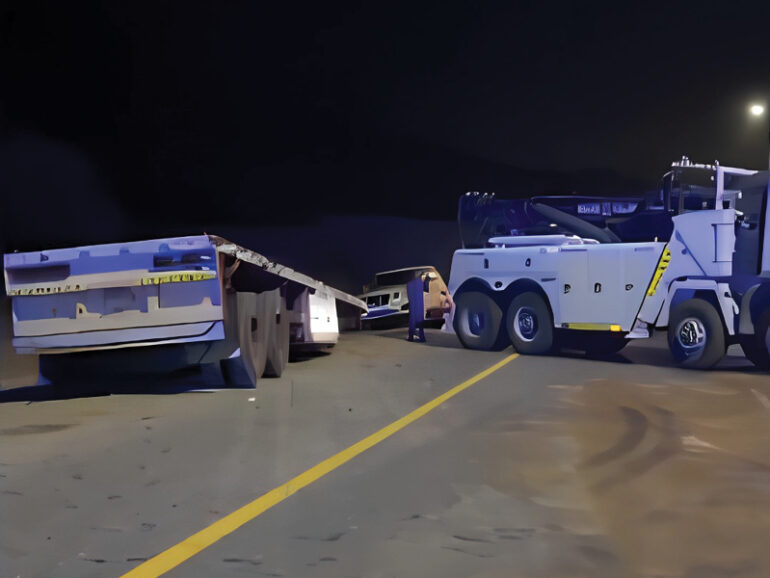
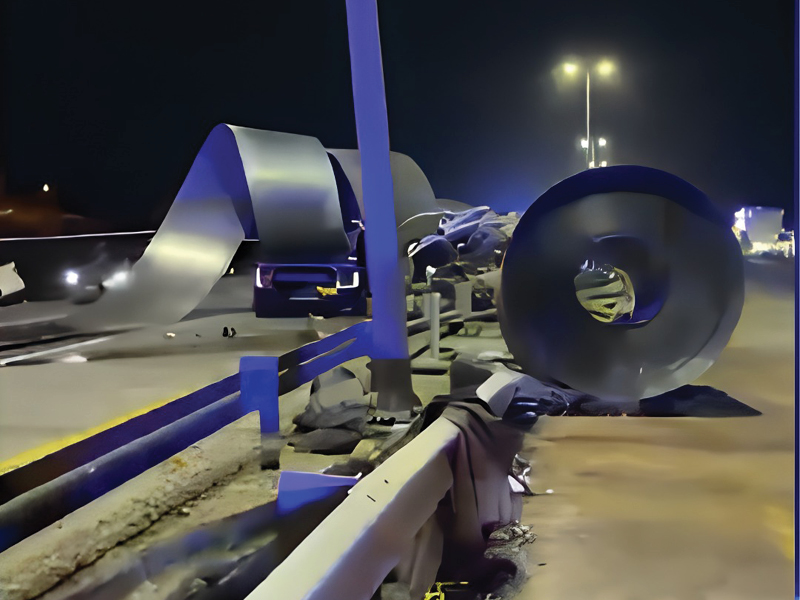
The accident involved a trailer carrying heavy steel coils and triggered a major multi-vehicle collision on Sultan Thuwaini bin Said Road in the Wadi Bani Rawaha area on Friday night.
According to the Royal Oman Police (ROP), the truck encountered traffic congestion caused by an earlier accident near the site shortly before 8pm while travelling towards Muscat.
Major Mohammed bin Salam Al Hashmi, Director of Security Relations and Media at the ROP, said vehicles had built up on the road because of the earlier collision.
As the truck reached the congestion, the driver lost control and the steel coils became dislodged. The vehicle veered into the opposite carriageway, while the coils were thrown across the barriers separating the two directions of traffic.
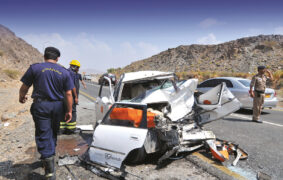
The sequence caused a chain collision involving several vehicles, some of which were severely crushed. A total of 15 vehicles were involved in or damaged by the accident, according to the ROP.
Six people died and 18 sustained injuries of varying severity, including eight who were reported to be in critical condition.
The Ministry of Transport, Communications and Information Technology’s Transport Safety Office has launched an investigation to establish the causes and contributing factors.
The tragedy has also prompted renewed public debate over truck speeds, overtaking, load security, driver working hours and restrictions during peak traffic periods.
Assad Al Mammari called for stronger action against drivers who violate traffic rules.
“Trucks are overtaking in prohibited areas, including bends and uphill sections, and suddenly changing lanes at low speeds while you are travelling at the legal speed limit of 120km/h,” he said. “This can catch drivers off guard and increase the risk of a collision.”
Khalaf Al Alwai said authorities should strengthen enforcement and increase checks on heavy vehicles. “The authorities concerned should tighten traffic laws and increase checkpoints, particularly for heavy trucks, while imposing stricter penalties to deter reckless drivers and protect people’s lives,” he said.
Ghalib Abdullah suggested banning heavy trucks from overtaking altogether.
“I suggest that the Royal Oman Police tighten regulations governing heavy trucks and ban them from overtaking, as is the practice in several countries,” he said.
Hamed Al Rasbi called for greater accountability where unsafe driving or poorly secured loads contribute to serious accidents.
Hussam Al Balushi urged authorities to reduce speed limits in the area to 100km/h for cars and 80km/h for trucks, citing the road gradient and history of skidding incidents. He also called for additional speed cameras and radar systems.
Hilal Hamdan proposed limits on truck drivers’ daily driving hours and said dedicated routes or additional safety requirements should be considered.
Sultan Al Qatbi called for tighter monitoring of speeding, overtaking and weight limits, as well as restrictions on truck movements during peak periods. “Inspection stations for heavy vehicles and stronger coordination between police patrols and the transport ministry is needed to ensure compliance with safety regulations.”
© 2021 Apex Press and Publishing. All Rights Reserved. Powered by Mesdac