 By OUR CORRESPONDENT
Salalah – Archaeologists from the Italian Mission at Al Balid in Salalah have uncovered the near-complete remains of a 13th-century mosque buried beneath a mound in the heart of one of Oman’s most significant ancient settlements, shedding new light on the region’s medieval Islamic heritage.
The Italian Archaeological Mission at Al-Balid, operating under the University of Naples L’Orientale, revealed findings from its 2023–2024 field seasons, exposing what researchers describe as a substantial religious complex that had remained almost entirely concealed beneath mound BA074 in the Dhofar.
The mosque’s construction has been dated confidently to the Rasulid period of control over Dhofar – a dynasty that dominated trade and political power across southern Arabia and the Horn of Africa during the 13th and 14th centuries.
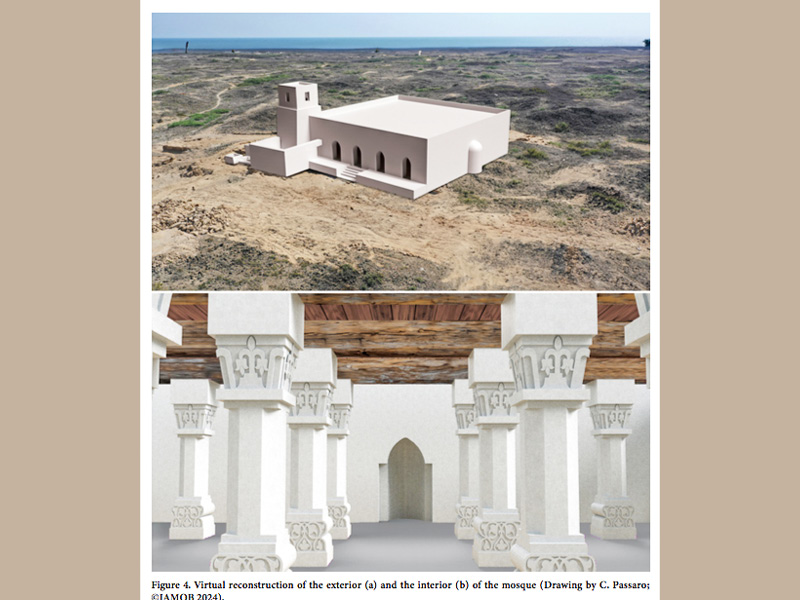
Excavations uncovered a hypostyle prayer hall measuring 14.5mX14.5m, supported by 16 monolithic columns originally set into square stone sockets. The hall’s nine doorways – one facing the qibla, three in the south wall and five in the north – opened onto a courtyard. The minaret, built against the northern end of the eastern wall, retains a sill rising roughly 1m from a rectangular base measuring 4.10mX3.30m. Both structures were built of local stone bonded with mortar, standing on a raised platform approximately 1m above street level.
Also unearthed were an ablution area with five interconnected stone basins fed by a hydraulic channel system, and a small funerary enclosure containing six stone-built graves oriented towards Mecca.
Among the artefacts recovered were locally produced and imported ceramics, Yemen yellow ware of the Rasulid period, fragments of enamelled and gilded glassware, coins, and decorative gypsum plaster carved with geometric and epigraphic motifs. Researchers also recovered five coins, a bone bead, and fragments of worked wood, possibly from a piece of furniture.
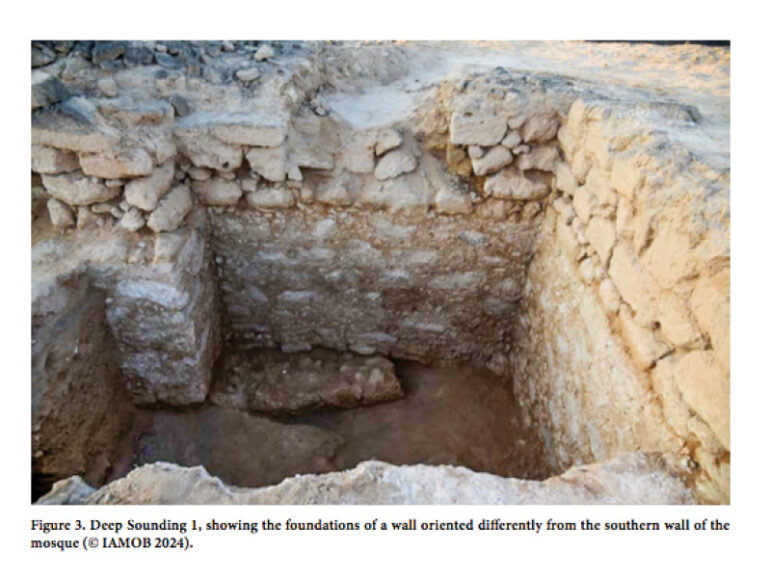
Evidence suggests the mosque was built over an even earlier structure, with trench excavations in the prayer hall’s south-western corner revealing foundation walls predating the Rasulid building – pointing to continuous religious use of the site across multiple centuries.
‘The building can be confidently dated to the 13th century, specifically to the period of Rasulid control over the Dhofar region,’ the mission stated in its findings published in Athar, the Bulletin of Archaeological Research in the Sultanate of Oman.
Mission architect Carlotta Passaro produced detailed virtual reconstructions of both the mosque’s exterior and interior, supported by drone photogrammetry and 3D modelling, offering a rare visual window into medieval religious architecture in southern Arabia.
The team plans to continue investigations in the south-western sector of the site in forthcoming field missions.
© 2021 Apex Press and Publishing. All Rights Reserved. Powered by Mesdac