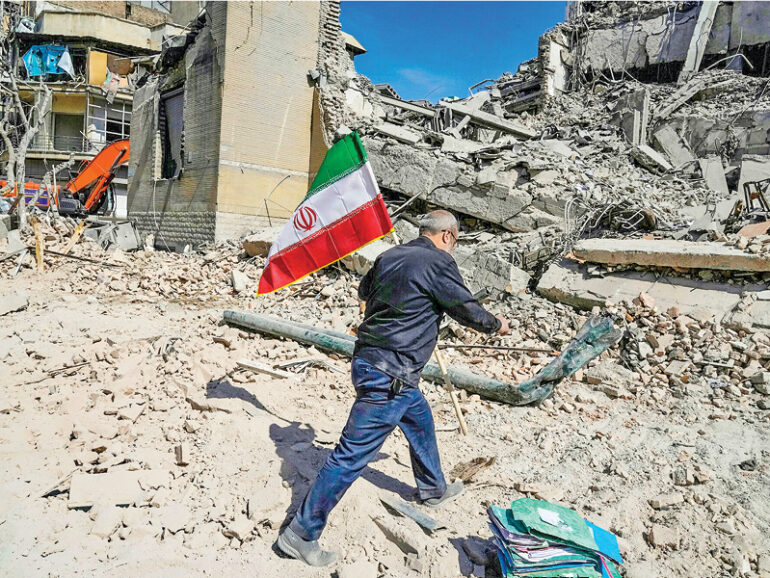
Washington, DC, US – The International Monetary Fund warned on Tuesday that war in the Middle East has sharply darkened the global economic outlook, citing disruptions to oil markets, rising inflation and an increased risk of recession.
In its latest World Economic Outlook, the IMF downgraded global growth forecasts, saying the conflict had interrupted what had been a steady recovery from the pandemic, the war in Ukraine and the inflation surge of recent years.
“The global outlook has abruptly darkened following the outbreak of war in the Middle East,” IMF chief economist Pierre-Olivier Gourinchas said. He cautioned that even a short-lived conflict would leave lasting economic damage.
Under its reference scenario, which assumes the Iran-US conflict eases and energy markets stabilise in the second half of 2026, the IMF expects global growth to slow to 3.1% this year from 3.4% in 2025. That is below the 3.3% forecast issued in January. Oil prices are projected to average US$82 a barrel in 2026 under this baseline.
However, Gourinchas said developments on the ground suggest the outlook may already be shifting towards a more adverse scenario. Prolonged energy disruptions could push oil prices to around US$100 per barrel this year, cutting global growth to 2.5%.
In a severe scenario involving extended conflict into next year and major supply shocks, global growth would fall to 2%, a level historically associated with recession. Oil prices could average US$110 per barrel in 2026 and US$125 in 2027. Global inflation could exceed 6% under that outcome, compared with 4.4% in the most-optimistic reference scenario.
“The downside risks are tremendous,” Gourinchas said, adding that persistent energy shocks could unanchor inflation expectations and force central banks to tighten monetary policy more aggressively.
Higher oil and energy commodity prices are expected to raise production costs for goods such as steel and cement, eroding household purchasing power and weighing on consumption.
The IMF said low-income and developing economies would be most exposed, alongside Gulf energy exporters facing infrastructure damage and export disruptions. Advanced economies are likely to fare better but would not escape the impact. US growth is projected at 2.3% in 2026, slower than earlier forecasts.
Without the conflict, the IMF said it would have modestly upgraded its global growth outlook, supported by investment in technology, easing interest rates and fiscal support in some economies.
The warnings came as policymakers gathered in Washington for the IMF and World Bank spring meetings, with the conflict now dominating discussions on global stability and financial risks.
IMF’s three economic scenarios
Short-lived conflict
Oil averages around $82 in 2026
Global growth slows to 3.1% (from 3.4% in 2025)
Global inflation at 4.4% in 2026
Prolonged disruption
Oil hovers near $100 this year
Global growth drops to 2.5%
Heightened pressure on inflation, interest rates
Extended and deepening conflict
Oil averages $110 in 2026, $125 in 2027
Global growth falls to 2%, near recession threshold
Global inflation exceeds 6%
© 2021 Apex Press and Publishing. All Rights Reserved. Powered by Mesdac