
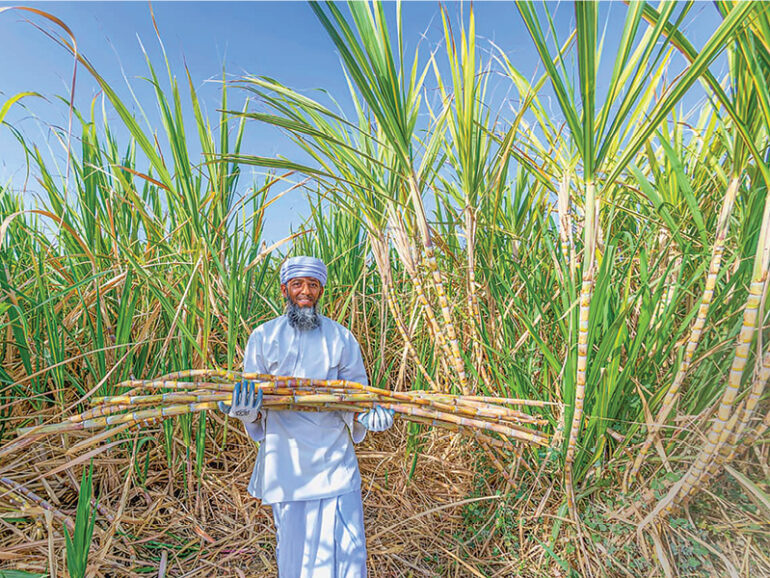
Muscat – The sugarcane harvest season in Oman has officially begun, with farmers across several governorates starting to collect the crop. Harvesting activities are expected to continue throughout April, marking an important period for local agriculture and traditional food production.
Early signs point to a strong season, as favourable environmental and climatic conditions have contributed to healthy crop growth and higher expected yields. The harvest has already commenced in the wilayats of Manah and Adam in Dakhliyah governorate, one of the country’s key sugarcane-producing regions.
In the coming weeks, harvesting will expand to other wilayats in the governorate, including Bidbid, Samail, Izki, Nizwa, Bahla and Al Hamra. Farmers in these areas rely on sugarcane cultivation as a traditional seasonal activity that supports both local markets and small-scale industries.
The harvest will also soon begin in farms located in wilayats across other governorates, including Dhahirah, North Sharqiyah, North Batinah and South Batinah, where sugarcane is cultivated in suitable agricultural areas.
Dakhliyah governorate remains particularly known for its large-scale sugarcane production. The region hosts a number of traditional and modern grind presses used to extract juice and process the crop into a variety of products. During the harvest season, local markets witness increased activity as farmers and producers offer freshly processed sugarcane products to consumers.
The crop is utilised almost entirely, reflecting the efficiency of traditional agricultural practices. Sugarcane is processed to produce a range of popular local products such as red sugar, balooj, sharj, khameer and sugarcane molasses, locally known as zeej. By-products from the crop are also used as livestock feed and natural fertiliser, while leftover cane stalks are commonly used as firewood.
Sugarcane belongs to the grass family and is considered a water-intensive crop, requiring significant irrigation. It is typically grown in warm climates and remains in the soil for extended periods, often close to a full year, making it an important source for sugar production and traditional food products in Oman.
© 2021 Apex Press and Publishing. All Rights Reserved. Powered by Mesdac