 By OUR CORRESPONDENT
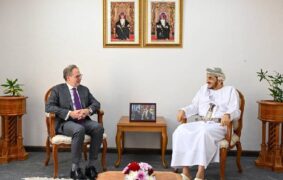
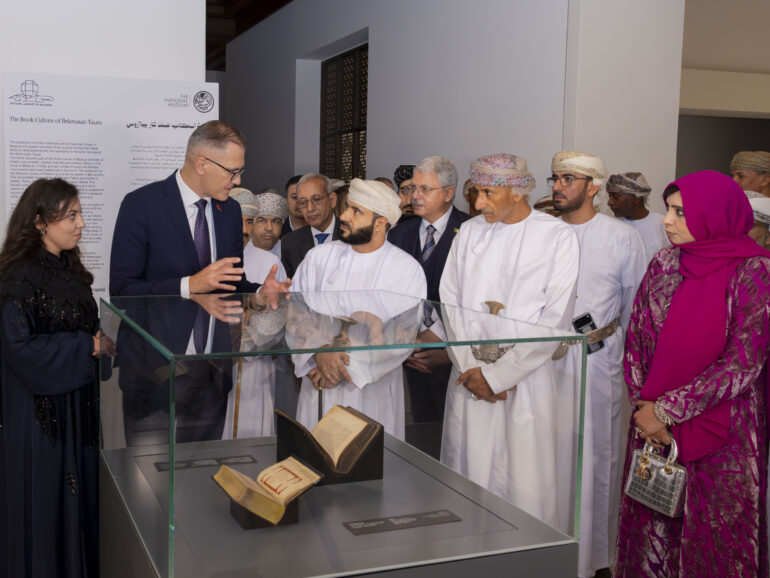
Muscat – The National Museum, in cooperation with the National Library of Belarus, today, Wednesday, 9 September 2026, opened the exhibition “The Book Culture of Belarusian Tatars”. The exhibition is held under the patronage of His Excellency Dr Mohammed bin Said bin Khalfan al-Mamari, Minister of Endowments and Religious Affairs, and was attended by a number of officials and those interested in cultural and museum affairs.
The exhibition presents unique examples of the manuscript heritage of the Belarusian Tatars from the collections of the National Library of Belarus, highlighting some of the most notable written heritage produced by Muslims that reflects their cultural and religious identity. The exhibition forms part of efforts to showcase the cultural diversity of Belarus and highlight examples of the contributions made by Muslim communities to the preservation and transmission of knowledge across generations. The exhibition will run until 6 November 2026.
Mr Vadzim Hihin, Director General of the National Library of Belarus, said: “The written heritage of the Belarusian Tatars represents one of the most valuable and significant parts of Belarusian history. It provides a window into a unique cultural phenomenon, reflecting the exceptional heritage of the Belarusian Tatars, who preserved their religion and identity while becoming an integral part of national life in Belarus. This exhibition not only showcases these heritage treasures, but also serves as a symbol of the growing ties between the Republic of Belarus and the Sultanate of Oman, reflecting our shared respect for history and our commitment to safeguarding cultural heritage. Cooperation in the field of preservation and restoration also provides a bridge connecting the past with the future and strengthens efforts to protect these treasures for generations to come.”
He added: “Our cooperation is not limited to this exhibition. We express our deep gratitude to the National Archives and Records Authority and the National Museum of the Sultanate of Oman for their pioneering initiative to launch a specialised training programme for conservators from the National Library of Belarus. This programme enables the exchange of expertise, strengthens conservation and restoration skills, and helps safeguard these heritage treasures for future generations. This cooperation represents a bridge between our two countries, linking the past with the future and contributing to the protection and study of the rich Islamic book culture.”
The exhibition includes a number of Qur’anic manuscripts dating from the first quarter of the 19th century to the beginning of the 20th century. These manuscripts bear the names of their copyists and owners, including a copy transcribed by “Zdanovich Yakub”. The Qur’anic manuscripts are notable for the variety of languages used in them, with Arabic texts appearing alongside Turkish, Belarusian and Polish, all written using the Arabic script.
The exhibition also features Qur’anic commentaries dating from the late 18th and early 20th centuries, as well as kitabs — varied, thematically diverse collections of handwritten texts dating from the second half of the 19th century and the beginning of the 20th century. These manuscripts record the places where they were copied and the names of their copyists, such as “Ibrahim Khasinevich” and “Hasan Mishutovich”.
Another section of the exhibition is dedicated to examples of some of the most widely circulated books among the Belarusian Tatars: small prayer booklets known as hamails. These were produced in the late 19th and early 20th centuries in cities such as Slonim and Minsk, as well as in other parts of Belarus.
The exhibits are not limited to religious works. The exhibition also includes part of a medical book dating from the end of the 19th century, written in Belarusian and Polish using the Arabic script, alongside examples relating to the teaching of reading and writing and to literacy. These materials demonstrate the broad functions of the manuscript book among the Belarusian Tatars, extending beyond the religious sphere into knowledge, education and everyday life.
Manuscripts written in Arabic script are among Belarus’s most precious cultural heritage treasures, having been produced by the Belarusian Tatars over many centuries. Only a limited number of these manuscripts have survived worldwide, while the National Library of Belarus holds one of the country’s largest and most important collections.
These manuscripts were written in Arabic, Turkish, Belarusian and Polish, all using the Arabic script. Muslims in Belarus developed a distinctive alphabet based on Arabic script, enabling them to represent the sounds of the Belarusian language with a high degree of accuracy. It came to be regarded as one of the writing systems most capable of representing these sounds compared with other alphabets.
The Belarusian Tatars are an integral part of Islamic civilisation. Over generations, they became integrated into the social, political and everyday life of Belarus, sharing the country’s history, with all its joys and challenges, while at the same time preserving their culture, traditions, religion and distinctive identity.
It is worth noting that the National Library in Minsk is the largest library in the Republic of Belarus. Established in 1922, it houses millions of books and documents. Its modern building is distinguished by a unique multifaceted architectural design and contains reading rooms, a conference centre and an observation deck overlooking the city, making it a prominent cultural and architectural landmark.
The exhibition was accompanied by a lecture on the book culture of the Belarusian Tatars, delivered by Ms Krystsina Yermak, Head of the Department of Cultural Heritage of the Republic of Belarus. The lecture explored the manuscript heritage of the Belarusian Tatars, highlighting the distinctive nature of this heritage, which brings together Arabic script with the Belarusian, Turkish and Polish languages, reflecting centuries of cultural and religious interaction in Eastern Europe.
The lecture also examined the historical background of the Tatars’ settlement in Belarus and the development of the writing system they created to use Arabic letters to represent the sounds of the Belarusian language. It also introduced the principal types of manuscripts, including Qur’ans, commentaries, books and hamails. The lecture highlighted the linguistic, literary and historical significance of these manuscripts and their role in documenting the transmission of Islamic knowledge and cultural coexistence. It also emphasised the importance of preserving, restoring and digitising these materials and making them accessible to future generations and researchers, as they provide a living testament to cultural diversity and the shared heritage of civilisations.
© 2021 Apex Press and Publishing. All Rights Reserved. Powered by Mesdac