
Muscat – A conflict that US President Donald Trump predicted would end “very fast” reached its 100th day on Sunday, with fighting continuing across multiple fronts despite ceasefire agreements and repeated diplomatic efforts.
What began as a US-Israeli military campaign against Iran has evolved into a broader regional conflict, leaving thousands dead, displacing millions and disrupting global energy markets.
Rising death toll
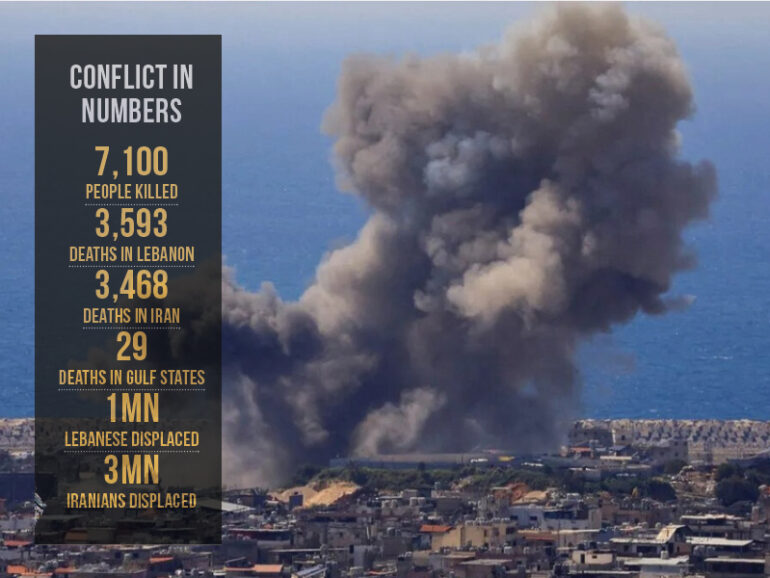
Preliminary figures indicate that more than 7,100 people have been killed since the war began.
Lebanon has recorded the highest toll, with 3,593 deaths, followed by Iran with 3,468. A further 29 people have been killed in Gulf states. Iranian attacks have also claimed the lives of 26 Israelis and 13 US military personnel.
Despite a separate ceasefire that took effect in Lebanon on April 17, military operations have continued in the country’s south.
More than 1mn Lebanese have reportedly been displaced by the fighting. Lebanese Prime Minister Nawaf Salam has described the campaign as “a scorched-earth policy and collective punishment”, accusing Israel of destroying towns and villages and forcing residents from their homes.
By early June, Israeli forces had advanced to the outskirts of Nabatieh and captured the historic Beaufort Castle. The advance marks Israel’s deepest military push into Lebanon in more than 25 years.
Israeli troops are now reported to control nearly 2,000sqkm, equivalent to about one-fifth of Lebanese territory.
In Iran, more than 3mn people were displaced during the first weeks of the war as US-Israeli strikes targeted infrastructure and urban areas.
Humanitarian agencies have warned that prolonged fighting could place additional pressure on already stretched relief operations across the region.
Energy markets rattled
The Strait of Hormuz, one of the world’s most important energy corridors, has become a major casualty of the conflict.
Before the war, around 100 vessels passed through the strategic waterway each day. Ship-tracking data shows that between late February and the end of May, only 607 ships transited the strait, averaging fewer than seven vessels daily.
The disruption has fuelled concerns over global energy supplies. Brent crude, which traded at about US$70 per barrel before the conflict, surged above US$100 and briefly approached US$120 before settling near US$100.
The International Energy Agency has described the situation as one of the most significant disruptions to energy markets in recent decades.
Diplomacy struggles
Efforts to secure a negotiated settlement have repeatedly stalled.
The latest ceasefire between the US and Iran, brokered by Pakistan, took effect on April 8 and was intended to halt hostilities for two weeks and reopen diplomatic channels. The agreement also included provisions aimed at restoring shipping through the Strait of Hormuz.
However, hopes for de-escalation faded quickly. Within hours of the ceasefire taking effect, Israeli forces launched more than 100 air strikes across Lebanon, reportedly killing over 250 people.
No clear end in sight
As the war enters its fourth month, ceasefires remain fragile and diplomatic initiatives continue to face setbacks.
With casualties mounting, displacement increasing and energy markets under pressure, the conflict’s consequences are being felt far beyond the immediate battlefield, raising fresh concerns about regional stability and global economic security.
Agencies
© 2021 Apex Press and Publishing. All Rights Reserved. Powered by Mesdac