 By MOHAMMED TAHA
Muscat – Oman is stepping up efforts to build an integrated semiconductor manufacturing ecosystem, aiming to establish a foothold in the global digital economy despite the high costs and technical barriers associated with the industry.
Speaking to Muscat Daily, officials said the strategy focuses on boosting capabilities in chip design, research and development, and forging international partnerships, while positioning the sultanate within global supply chains that underpin the sector.
“The semiconductor industry is among the most complex and influential sectors in the digital economy,” said Nasriya Nasser Al Hinai, e-business development specialist at the Ministry of Transport, Communications and Information Technology. She noted that entering the field requires substantial investment, advanced expertise and specialised infrastructure, alongside access to tightly controlled global supply networks.
She added that emerging economies face additional challenges, including shortages of skilled talent and the high cost of design and manufacturing tools.
Despite these challenges, Oman has made early progress by developing semiconductor chips as part of its broader digital transformation agenda under Vision 2040, signalling a shift towards participation in global value chains and the development of domestic technical capabilities.

According to Nasriya, the initiative has progressed through multiple stages, including research, partnership development, circuit design, simulation and testing. Manufacturing is currently carried out through specialised facilities abroad, followed by final performance verification. These phases have required close coordination between government entities, academic institutions and private sector partners.
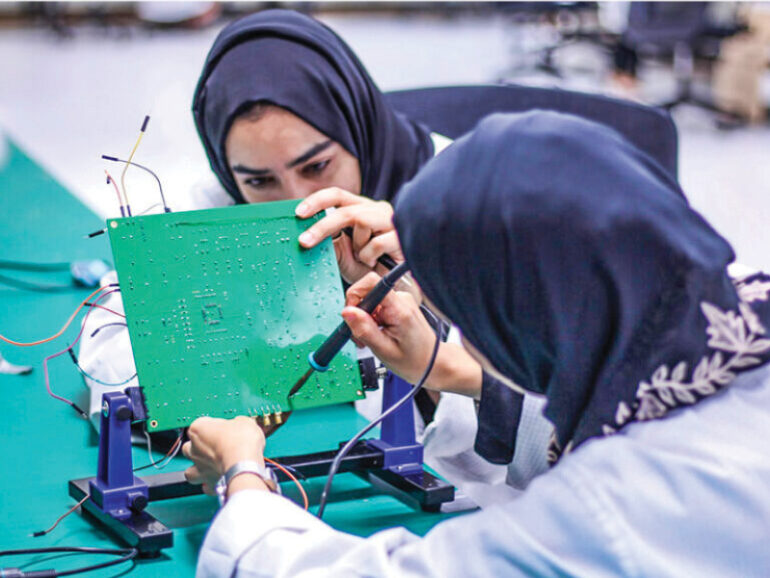
Around 100 Omani engineers have contributed to the design and development phases, working on circuit design, testing and project management while liaising with international partners. Training programmes continue to expand the national talent pool and address gaps in specialised skills.
In the absence of advanced local fabrication facilities, manufacturing is currently conducted overseas, underscoring Oman’s reliance on global production networks. Nasriya said this approach allows the country to prioritise higher-value segments such as design and innovation, while continuing to assess the long-term feasibility of establishing domestic fabrication capabilities.
The initiative is expected to support key sectors, including telecommunications, energy, defence and automotive industries, as well as applications related to the Internet of Things.
Nasriya added that the long-term objective is to establish a comprehensive semiconductor ecosystem encompassing design, research and startup development, supported by sustained investment and long-term planning.
Looking ahead, Oman plans to expand research activities, develop new chip generations and strengthen international cooperation, as part of broader efforts to diversify the economy, create skilled employment and build a knowledge-based industrial base.
© 2021 Apex Press and Publishing. All Rights Reserved. Powered by Mesdac