Tbilisi, Georgia – Georgia has grappled with political tension and months of street protests, but President Mikheil Kavelashvili defended the legitimacy of the country’s 2024 parliamentary elections and its path to become an European Union (EU) member.
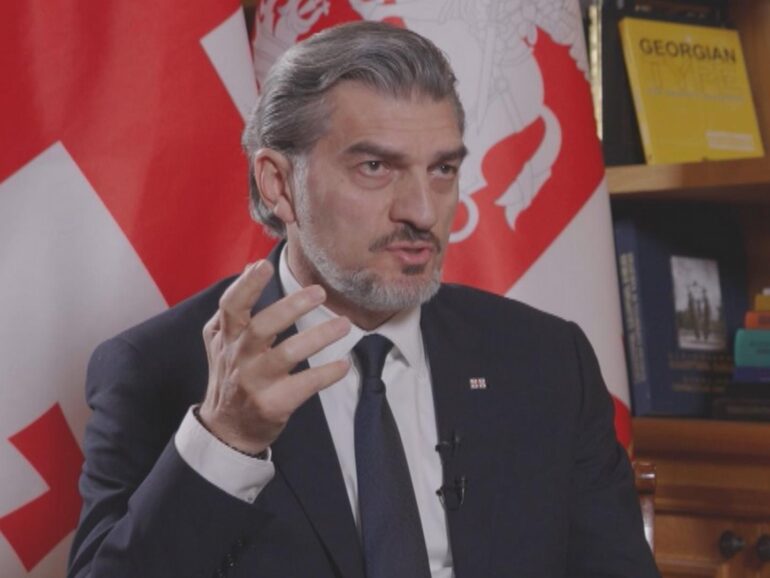
DW correspondent Juri Rescheto spoke exclusively with Kavelashvili, who insisted the election delivered a credible mandate for the ruling Georgian Dream party.
“I have been in politics for the last 10 years,” Kavelashvili told DW. “Compared to all previous ones, the most recent elections went off better than any before. Without any violations.”
Georgian Dream won the parliamentary elections in October 2024, but the vote was mired in allegations of fraud and it led to ongoing protests.
The European Parliament and international election observers have also noted shortcomings in Georgia’s democratic processes, highlighting an ongoing tension between the government’s claims and external assessments.
Call for EU membership push
Protesters have repeatedly demonstrated against the government’s decision to halt talks on joining the EU. Georgia’s ruling Georgian Dream party has tried to curb the movement by tightening rules on public assemblies,
Kavelashvili said the government remains committed to a European future, despite the fact that accession talks were frozen, but noted a decline in support for joining the EU.
“The Georgian Dream government never refused to join the EU,” he explained.
“If 80% of the population supports joining the EU, and 60% supports Georgian Dream, what does that mean? It turns out the majority supports both EU membership and Georgian Dream.”
Timeline on joining EU uncertain
Polling shows roughly three-quarters of Georgians favour EU integration. Looking ahead, Kavelashvili was cautious about providing a timeline.
“By 2030 Georgia will be ready to join the EU, but right now we don’t know whether the EU’s view will change or stay the same,” he said. “Sometimes they recognise this government, and sometimes they don’t. It’s absurd.”
He argued the EU must ‘change its attitude towards Georgia’, starting with media coverage, if the country is to join the bloc.
One of the sticking points is the ‘foreign agent’ law.
Critics describe it as ‘the Russia law’, because it is similar to one used by the Kermlin and said it could be used to threaten civil liberties
It requires non-governmental organisations and print, online and broadcast media that received more than 20% of their annual revenue from ‘a foreign power’ to register with the Ministry of Justice as ‘organisations serving the interests of a foreign power’.
However, Kavelashvili, said: “This law is about transparency. NGOs are obliged to show all their documentation and be transparent about their spending, there’s nothing more to it than that.”
Constitutional issues at heart of protests
Despite Kavelashvili’s insistence that Georgian Dream maintains strong support, political divisions persist, reflected in the ongoing protests.
Kavelashvili dismissed the protesters as misled and externally influenced, claiming they serve foreign interests opposed to Georgia’s ties with the EU and do not act for citizens’ welfare.
Commenting on constitutional matters, Kavelashvili highlighted his government’s approach, saying: “We are proud of our Constitution. It clearly guarantees the civil rights of all citizens, including minorities. Discrimination in any form is unacceptable.”
DW
© 2021 Apex Press and Publishing. All Rights Reserved. Powered by Mesdac