
The exhibits currently on display in a unique solo exhibition at Bait Muzna Gallery are a few hundred years old….or so you would think. And you would, indeed, resist the temptation to touch and feel what could take you back through time, as some of the decayed and degenerated artefacts appear to crumble and fall apart at the slightest touch.
Intricate weaves of palm fronds used to create mats and rugs, thatched roofing and blinds, household essentials and furniture of a bygone era in Oman, are on display through the exhibits. The surprise factor, however, is the fact that these are not light-weight originals, rather true-to-life representations of the originals, cleverly cast in heavy metals with painstaking effort and eye for detail.
Yes, now you reach out and touch them. You knock on them and hear a resonance that hit you in the face as you simply don’t believe the craft and credibility of the artist’s deep-rooted quest to celebrate the past through contemporary artworks. The exhibits are created on porcelain, aluminium, bronze, and are quite heavy – they appear to be a preservable prototype of a dying craft that needs to be consciously passed down to the new generation despite the exposure to an ultra modern, high tech lifestyle these days.
Wagstaff is a sculptor and installation artist who claims to be influenced by conceptual art, design, and anthropology, and his current work features the physicality and psychology of culturally significant objects.
“My art includes references to my personal journey of inner healing and deconstruction of my worldview, in the context of living cross-culturally in the Middle East,” he states, adding, “As an artist, I enjoy making 3-dimensional work and curating experiences. I appreciate all mediums, ranging from performance and installations, to sculpture and prints, using whatever is necessary to convey the message.”
About the current exhibition, Wagstaff disclosed that he had taken a fascination for an ancient traditional art in Oman and travelled to different parts of Oman to encounter, understand, research and dig out, not just the social and cultural aspects, but also the spiritual roots of traditional Omani Haseer mats had been the focal point of most activity within the household as well as the community. The Haseer mat, he discovered, had a special place in every individual’s personal life as well as a distinct dimension in the community he/she was involved with. It connected, not just people but also individuals with different aspects of their inner being and persona.
Pointing towards a set of artworks that depict how traditional prayer mats appeared in the days of yore, Wagstaff explains, “Many people have forgotten that this is how prayer mats used to look. These portable mats foster a scred meditative space where we deepen our connection with God, reflected in the behaviours that it produces. Even though the mat deteriorates over time, it reflects the opposite of how our spirits are built up over the time we have spent in this space.”
The exhibits on display have been created over the past four years, though he has been in Oman for sever odd years. Explaining the tedious craft behind creating each piece, he says, “To produce the bronze pieces, I had to bring the Omani mats to China where I could find a factory that could cast them. The journey took me six weeks and I had to convince the craftsmen to use colours that they hadn’t used before.”
Explaining the significant role Haseer mats played in family/community gatherings, in schooling, in weddings, even in funerals, Wagstaff said, “There is no prestigious position around the Haseer mat. It creates a sacred and beautiful space, and everyone becomes equal and united around this mat. It signifies the best aspects of the culture in Oman.”
Hoping to get his artworks sold during the exhibition, which opened on February 22 and would continue for a month till March 22, Wagstaff, however, expressed the desire to be able to showcase it at prestigious galleries in the region to showcase not just the crafts but also the vibrant culture of a bygone era in Oman
Haseer mat
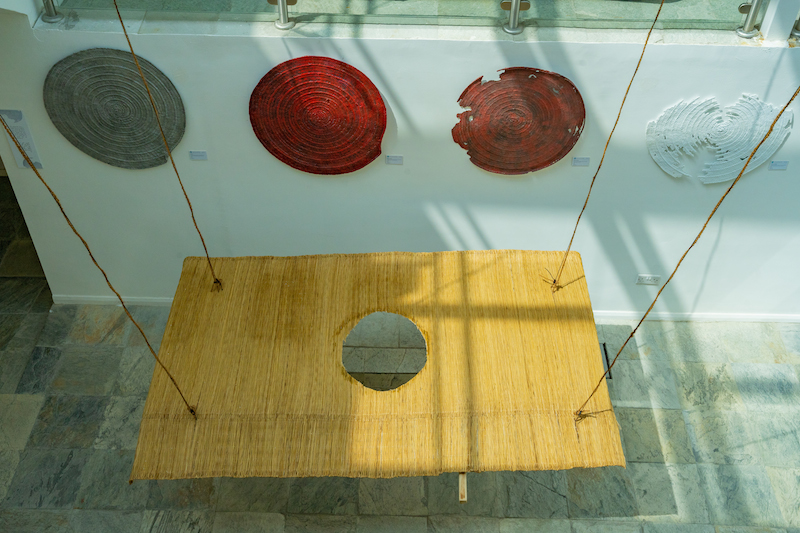
Haseer mats are traditional hand-woven mats made from date palm leaves and wadi reeds which are in abundance in Oman. The craftsmen who create these Haseer mats are now not many in number. Wagstaff uses visual representation to highlight the subconscious symbolism behind the Haseer, being a valuable component that brings together the beauty of local culture and values. Through sculpture and installation, he explores the idea of time and inevitable evolution of culture and tradition.
With his current works, Wagstaff observes how people come together on the Haseer, how it immediately creates a sacred and holy space where one connects with the Almighty and others – where everyone is equal, where there is safety, peace, rest, even engulfed by danger.
© 2021 Apex Press and Publishing. All Rights Reserved. Powered by Mesdac