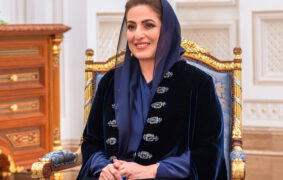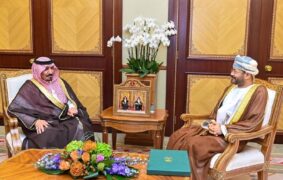

The Sultanate of Oman on Monday marked the centenary of its oil and gas journey in a ceremony held at the Royal Opera House Muscat under the patronage of HH Sayyid Shihab bin Tarik Al Said, Deputy Prime Minister for Defence Affairs.
In his keynote address, Eng. Salim Nasser Al Aufi, Minister of Energy and Minerals, said the completion of 100 years since the first step in oil exploration represents “a defining moment in Oman’s modern history”, reflecting the perseverance of generations who built a sector that today forms one of the strongest pillars of the national economy.
Al Aufi recalled that Oman’s oil story began with the signing of the first concession agreement with the D’Arcy Exploration Company on 18 May 1925. The foundational phase followed with the drilling of the Dauka-1 well in 1955, before the transformational Fahud discovery that set the sector on a new trajectory. The first export shipment of Omani crude departed Mina Al Fahl in 1967 with an initial output of 5,000 barrels per day (bpd). Today, production stands at nearly one million bpd, a testament to the accumulated expertise and the advanced operational, administrative, and technical systems developed over the decades.
He stressed that Oman’s political stability has played a central role in reinforcing investor confidence and attracting international partners. Among the most notable results of such collaboration is the Duqm Refinery and Petrochemical Industries project, launched last year with investments exceeding RO 3.5bn.
Al Aufi said concession area management has evolved significantly, with 58 areas now under the sector’s purview, including 34 operational blocks managed by 16 companies adhering to the highest standards of governance. Oman’s current oil reserves are estimated at around 4.8bn barrels, while natural gas output averages 150mn cubic metres per day, supported by an extensive pipeline network spanning thousands of kilometres.
On In-Country Value (ICV), he noted that the sector spent RO 11bn over the past decade, including RO 700mn directed to SMEs in 2024 alone. This year also saw the launch of the “Majd” ICV programme, with Abraj Energy Services receiving the first accreditation certificate in the energy and minerals sector.
Human capital, he underscored, remains the sector’s greatest strength, with nearly 20,000 employees in operating companies and an Omanisation rate of 93%. The industry registered 285.5mn working hours without a Lost Time Injury in 2024, reflecting a deeply entrenched safety culture.
Al Aufi highlighted that operating companies have invested close to RO 50mn in community initiatives over the past five years, reaffirming their commitment to social responsibility. “Marking 100 years is a tribute to a national journey forged by determination and knowledge,” he said, adding that Oman remains committed to advancing the sector as it enters a new era of energy transition.
The ceremony also saw the unveiling of a commemorative postage stamp celebrating the centenary of Oman’s oil and gas industry, serving as a historical record of the sector’s evolution.
Speeches highlighted the central role of oil and gas in establishing the foundations of the national economy, driving infrastructure development and supporting transport, industry, communications, trade, investment, and logistics. The sector has also enabled education and innovation through its support of universities, research institutions, and specialised training programmes.
Environmental initiatives were also showcased, including major green projects such as PDO’s Miraah solar steam facility, the Wetland project in Nimr, the eco-friendly Nimr Water Treatment Plant, and renewable ventures like the 100MW Amin Solar Plant and the Riyah 1 and Riyah 2 wind projects. Operating companies are also supporting solar power for schools and green hydrogen development, including Oman’s first station launched by Oman Shell.
As part of the celebrations, an exhibition chronicling 100 years of oil and gas exploration was inaugurated. Open to visitors until Wednesday, the exhibition features documentary and visual displays, historical documents, models and samples from the industry, a showcase of 100 infographic panels, and a chronological timeline covering the period from 1925 to 2025.
© 2021 Apex Press and Publishing. All Rights Reserved. Powered by Mesdac